Teaspoons per gram of sugar: A Quick Guide to Accurate Conversions
If you're looking for the quick answer, it's this: one teaspoon of regular white sugar is equal to about 4 grams. This is the go-to conversion that makes it so much easier to understand what's on a nutrition label and actually picture how much sugar you're eating.
Your Quick Guide To Sugar Conversion
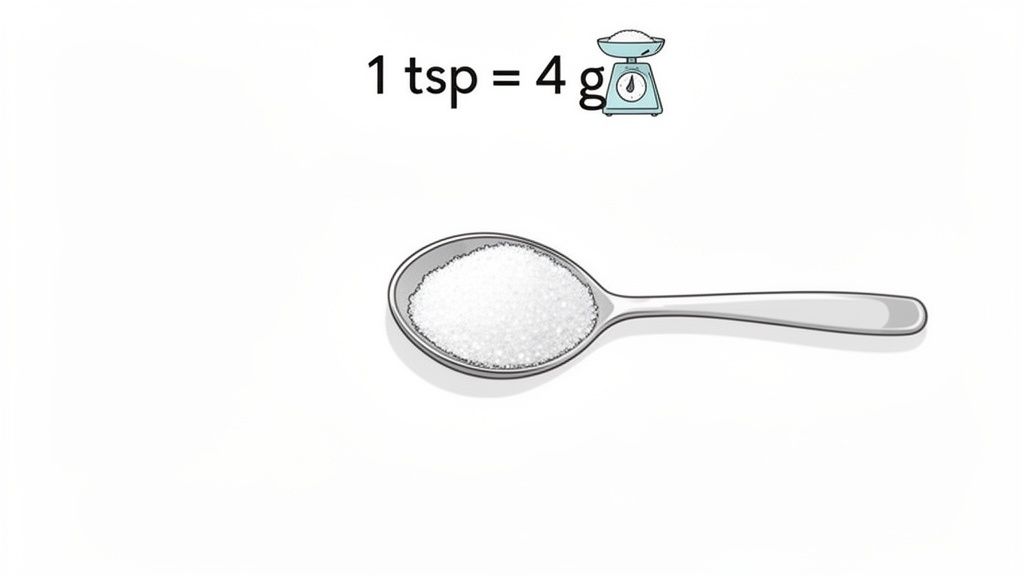
Getting a handle on how grams and teaspoons relate is the first step to truly managing what you eat. The industry standard is straightforward: a single, level teaspoon of granulated sugar weighs 4 grams.
This simple fact is key to decoding just how much sugar is in our food, especially when you hear health experts talking about the hidden sugars in everything from drinks to processed snacks. You can get a better sense of the scale of the issue by looking into some dietary sugar statistics.
Knowing this baseline helps you translate a confusing nutrition label into a real-world portion you can actually visualize. To make it even easier, here's a simple lookup table for common amounts you'll come across.
Quick Conversion For Granulated Sugar
| Teaspoons (tsp) | Grams (g) |
|---|---|
| 1 tsp | 4g |
| 2 tsp | 8g |
| 3 tsp | 12g |
| 4 tsp | 16g |
So, next time you see "16g of sugar" on a label, you'll know right away that it's the same as dumping four teaspoons of sugar into your food or drink.
Why a Teaspoon of Sugar Isn't Always 4 Grams
You've probably heard the go-to conversion: one teaspoon of sugar equals four grams. While that’s a great rule of thumb for regular white sugar, it's not the whole story. The reality is, the weight of a teaspoon of sugar can vary quite a bit depending on what kind you're scooping.
Think about it like this: a cup of feathers and a cup of rocks both fill the same space, but you know their weights are worlds apart. It's the exact same principle with sugar. A teaspoon of fluffy powdered sugar, for instance, weighs a lot less than the same spoonful of dense, packed brown sugar.
What Makes Sugar Weights Different?
A few key things influence how many grams can actually fit into that teaspoon. Getting a handle on these differences is key for anyone serious about tracking their sugar intake or nailing a recipe.
- Crystal Size: The finer the crystal, the more air gets trapped between the particles. That's why powdered sugar is so light. Coarser crystals, like you find in raw sugar, are denser and heavier.
- Moisture Content: Ever noticed how brown sugar is clumpy and moist? That’s because it contains molasses, which adds significant weight and makes it more compact than dry, granulated sugar.
- Form: Liquid sweeteners are a different ballgame entirely. Syrups like honey and maple are much denser than any granulated sugar, so a teaspoon will weigh quite a bit more.
Getting these measurements right is a big deal in the kitchen. In fact, understanding why a teaspoon of sugar isn't always 4 grams can help you sidestep many common cooking mistakes related to measurement.
A Quick Sugar Conversion Reference Guide
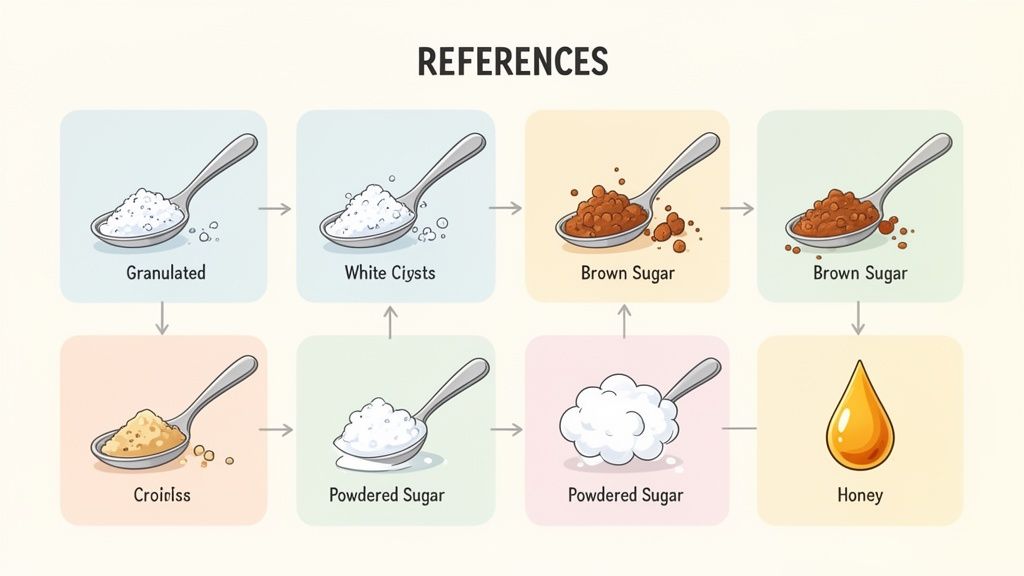
Whether you're baking a cake or just trying to keep an eye on your sugar intake, having a reliable conversion chart is a game-changer. The truth is, the teaspoons per gram of sugar isn't a one-size-fits-all number because different sugars have different densities.
This quick reference guide gives you the specific gram weights for the most common sugars and sweeteners you probably have in your kitchen right now. It's the key to getting your recipes right and accurately tracking what you eat.
This chart gives a great visual of how much the weight can vary just based on the size of the sugar crystals.
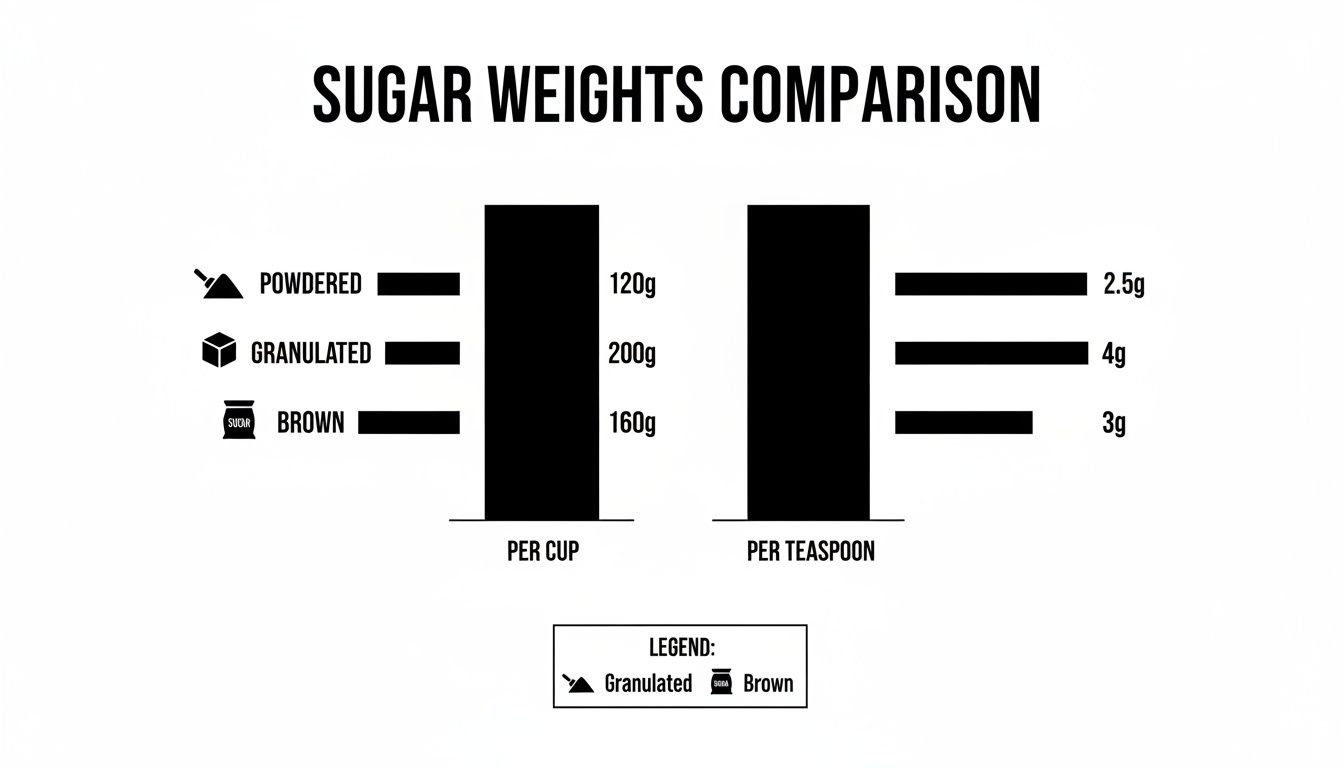
As you can see, the fine, airy nature of powdered sugar makes it much lighter than the denser granulated or brown sugars.
Grams Per Teaspoon For Common Sugar Types
Here's a breakdown of how much one level teaspoon of different sugars and sweeteners actually weighs.
| Type of Sugar | Grams (g) per Teaspoon (tsp) |
|---|---|
| Granulated White Sugar | 4.2g |
| Light Brown Sugar (Packed) | 4.0g |
| Dark Brown Sugar (Packed) | 4.3g |
| Powdered Sugar (Unsifted) | 2.5g |
| Raw/Turbinado Sugar | 4.5g |
| Coconut Sugar | 4.0g |
| Maple Syrup | 6.7g |
| Honey | 7.0g |
It's pretty clear from this table that not all sugars are created equal when it comes to weight.
The big surprise for many people is just how heavy liquid sweeteners like honey and maple syrup are. Because they're so dense, even a small spoonful can add a surprising number of grams to your daily count. This is definitely something to keep in mind when you're logging your meals in an app like StopSugar.
How to Read Sugar Content on Nutrition Labels
Knowing the conversion from grams to teaspoons is a game-changer, especially when you're standing in a grocery aisle. It’s one thing to read "Total Sugars" on a nutrition label, but it’s another to actually picture what that number means for your body.
Luckily, there's a really simple formula to translate grams into something you can visualize. Just divide the grams of sugar by four.
Formula: Total Grams of Sugar ÷ 4 = Teaspoons of Sugar
This quick mental math turns an abstract number into a concrete measurement. That small gram count suddenly looks a lot bigger when you imagine it as actual spoonfuls of sugar. Getting the hang of this is one of the most practical skills for managing your sugar intake. To go even deeper, this is a great guide on how to read various nutrition and supplement labels effectively.
Putting the Formula Into Practice
Let's look at a few common food items to see just how much sugar can be hiding in plain sight. It's often surprising how quickly those teaspoons add up.
- A 12-ounce can of soda: A typical can has about 39 grams of sugar. When you do the math (39 ÷ 4), you realize you're drinking almost 10 teaspoons of sugar.
- A single serving of breakfast cereal: Many popular cereals contain 12 grams of sugar per serving. That’s 3 full teaspoons of sugar before you’ve even added milk or fruit.
These numbers can be a real eye-opener. Think about it: the average American adult and teen consumes about 17 teaspoons of added sugar a day—that’s a whopping 68 grams. Imagine scooping 17 teaspoons of sugar into your morning coffee!
Once you start seeing grams as teaspoons, it becomes much easier to spot high-sugar foods and make healthier choices. For more tips, check out our guide on how to read nutrition labels for sugar content.
Seeing the Sugar in Your Daily Diet
Knowing how to convert grams to teaspoons is one thing, but the real eye-opener is using that skill on the foods you eat every day. You'd be amazed at how much sugar hides in items marketed as "healthy," making it all too easy to go way over your daily limit without even noticing.
Let’s look at a few common examples. A quick bit of math can completely change how you see the products lining grocery store shelves.
Where Sugar Hides in Plain Sight
Some of the biggest sugar bombs aren't desserts—they're the snacks and drinks we grab on the go. Once you start converting grams to teaspoons, you see just how much they're packing.
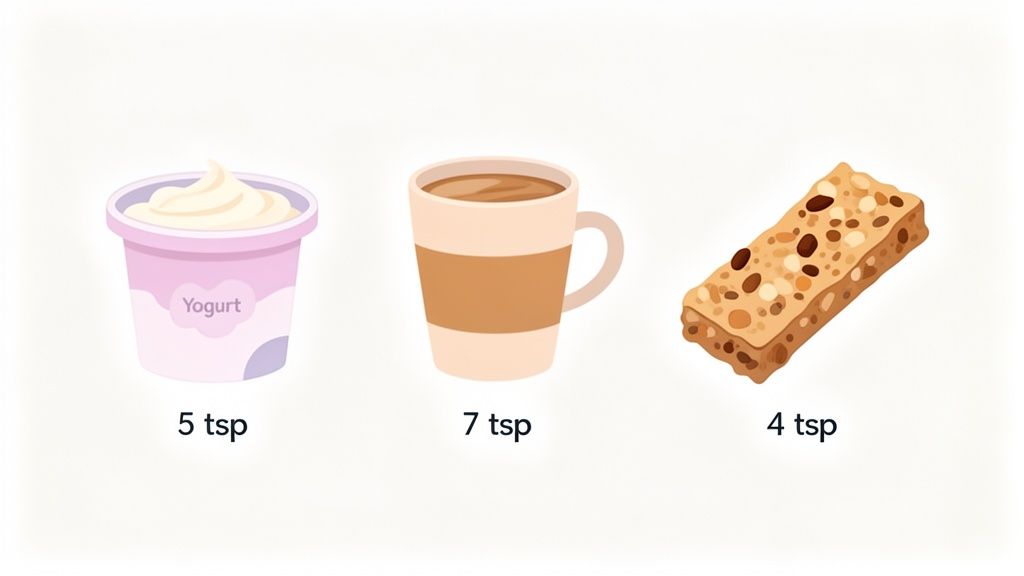
- Flavored Yogurt (6 oz serving): That single-serving cup often contains around 20 grams of sugar. Do the math, and that’s 5 teaspoons.
- Medium Flavored Latte: Your morning coffee ritual could be starting your day with 28 grams of sugar, which is a whopping 7 teaspoons.
- "Healthy" Granola Bar: Marketed as a wholesome snack, a single bar can easily have 16 grams of sugar. That's 4 teaspoons, usually from things like corn syrup or honey.
For perspective, the American Heart Association suggests women stick to no more than 6 teaspoons (25 grams) of added sugar per day, while men should aim for 9 teaspoons (38 grams). The trouble is, the average U.S. adult blows past that, consuming about 17 teaspoons daily.
These examples make it clear how just a few supposedly harmless choices can push you over the recommended daily limit before you've even had lunch. To get better at spotting these traps, check out our guide on finding hidden sugar in foods.
A Smarter Way To Track Your Daily Sugar Intake
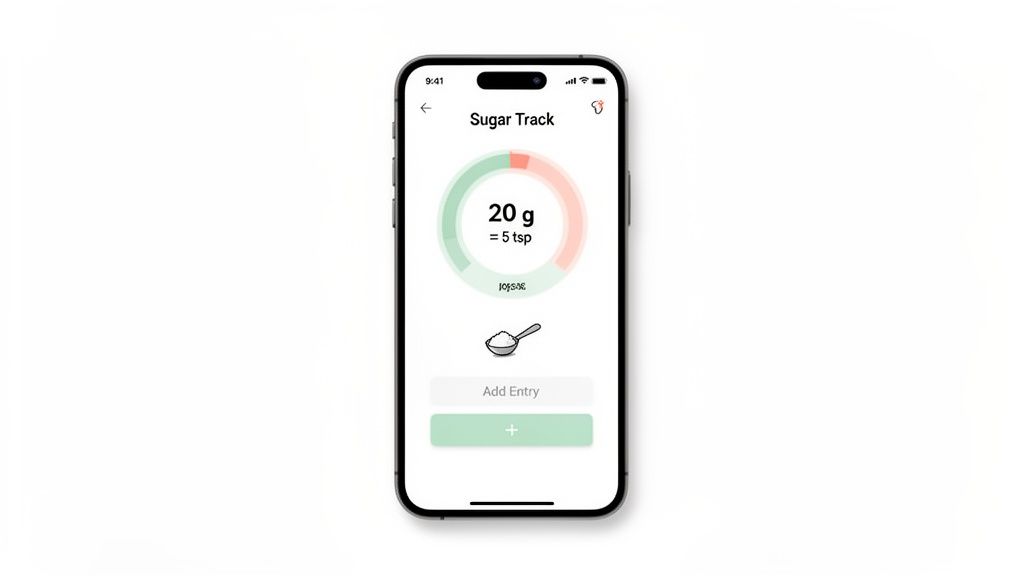
Knowing the math behind teaspoons per gram of sugar is a great start, but the real change happens when you apply it every day. Let's be honest, pulling out a calculator for every meal and snack is a hassle. This is exactly where a good tool can step in and make all the difference.
Using an app built specifically for sugar tracking, like StopSugar, takes all the tedious guesswork out of the equation. You can log what you eat in either grams or teaspoons, and the app instantly shows you where you stand against your daily goals. It's this kind of effortless consistency that helps build habits that actually stick.
Features That Empower Your Journey
The best tracking apps do more than just count numbers; they give you a clearer picture of how sugar is truly affecting your life.
- Daily Check-Ins: A simple way to log your sugar-free days, which helps build momentum and gives you small wins to celebrate along the way.
- Mood Tracking: Start connecting the dots between your sugar intake and your energy levels. You’ll begin to spot patterns and identify what triggers those slumps.
- Craving Support: Get access to on-the-spot resources, like a "panic button," that provide real strategies to help you navigate and overcome intense sugar cravings when they hit.
These features turn tracking from a chore into a tool for genuine self-awareness. When you can clearly see the link between what you eat and how you feel, you're much more motivated to stay the course.
When you actively monitor your intake, you're doing more than just counting grams. You're taking back control over your energy, mood, and long-term health. It’s all about making conscious choices instead of letting hidden sugars run your day.
Pairing your knowledge of sugar conversions with a smart app simply makes building healthier habits easier. If you want to get even more precise, consider using a daily sugar intake calculator to set personalized goals that make your tracking that much more effective.
Got Questions About Sugar Conversions? We've Got Answers.
It's totally normal to have questions when you start digging into the details of sugar. Even with a good chart, some things can still seem a bit fuzzy. Let's clear up a few of the most common questions that come up.
How Solid Is That "4 Grams Per Teaspoon" Rule?
That rule of thumb is actually quite solid, but only for regular white, granulated sugar. It’s the standard you'll see on nutrition labels, so for everyday tracking of processed foods, 4 grams per teaspoon is a fantastic shortcut.
But as we've seen, that number can shift once you start dealing with different types of sugar. Brown sugar, powdered sugar, and liquids like honey all have different densities. For pinpoint accuracy in baking or tracking these other sweeteners, it's always better to refer back to a conversion chart.
Does My Body Handle All Sugars The Same Way?
Not at all. While your body ultimately breaks down most sugars into glucose for fuel, the way it gets there makes a huge difference. For instance, the sugar from an apple comes packaged with fiber, which slows down digestion and prevents a sharp blood sugar spike.
Contrast that with the sugar in a soda, which hits your system all at once. It’s not just about the teaspoons per gram of sugar; the source is just as important. Whole foods give you vitamins and nutrients, while added sugars are just empty calories that can lead to energy crashes and other health problems.
So, What's The Best Sweetener To Use?
Honestly, the "best" choice comes down to your personal health goals and what you're using it for. Natural sweeteners like pure maple syrup and honey offer some trace minerals, but they're also denser and have more calories. Others might prefer an alternative like coconut sugar.
No matter what you choose, the real secret is moderation. Getting a handle on the gram-to-teaspoon conversion for your favorite sweetener is the key to staying in control of your intake. An app like StopSugar makes this a lot easier by helping you track any kind of sugar you use.