Why Do I Binge Eat at Night and How to Stop
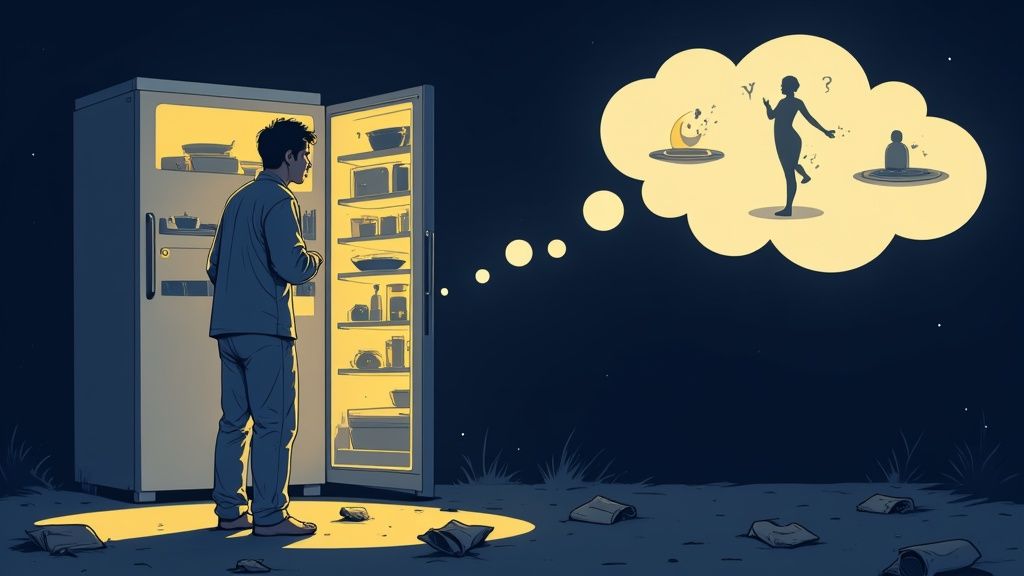
That intense urge to binge eat at night isn't a sign of weakness or a failure of willpower. It’s actually a predictable outcome—a perfect storm created by the collision of your daily habits, your biology, and your emotions. It often strikes when daytime food restriction meets end-of-day exhaustion, leaving your defenses at their absolute lowest.
This cycle is incredibly common, completely understandable, and most importantly, something you can absolutely change.
Decoding Your Nighttime Cravings
Ever found yourself staring into the fridge late at night, wrestling with an almost primal urge to eat? You are definitely not alone. This powerful drive is a shared experience, and figuring out why it happens is the first real step toward taking back your evenings.
The answer is rarely simple. Nighttime binging isn’t usually caused by just one thing; it’s the result of several factors that have been building up all day long. Think of your self-control like a muscle. You use it constantly—making decisions, managing stress, resisting small temptations. By the time night rolls around, that muscle is just plain tired.
While your willpower is depleted, your body is running its own agenda. If you’ve been restricting food all day, you’re left both physically and mentally deprived. Your body, sensing a major calorie shortfall, starts screaming for energy with powerful hunger signals. These signals become almost impossible to ignore when your mental guard is down.
The Key Triggers Behind the Urge
So, what are the specific forces pushing you toward the pantry? Let’s get a quick overview of the main culprits before we dive deeper into each one.
Here’s a snapshot of the primary factors that contribute to the urge to binge eat at night.
Key Triggers for Nighttime Binge Eating at a Glance
| Trigger Category | How It Contributes to Nighttime Binging |
|---|---|
| Blood Sugar Imbalance | Eating too little during the day causes blood sugar to crash, triggering intense cravings for quick energy (sugar and carbs) at night. |
| Circadian Rhythm | Your internal body clock naturally increases hunger hormones like ghrelin in the evening, making cravings feel stronger. |
| Stress & Exhaustion | High cortisol from stress and decision fatigue lowers your inhibitions, making it harder to resist comforting, high-calorie foods. |
| Restrictive Dieting | Under-eating creates a "rebound" effect where your body demands calories, and psychological restriction makes "forbidden" foods more appealing. |
| Habit & Routine | Nighttime eating can become an automatic behavior linked to cues like watching TV or finishing work, done without real hunger. |
| Emotional Triggers | Using food to cope with feelings like boredom, loneliness, or anxiety is common when you're tired and distractions are few. |
Getting to know these triggers is where the real power lies.
Understanding these triggers is empowering. It shifts the focus from blaming yourself for a lack of willpower to recognizing specific, solvable problems in your daily life.
Once you can pinpoint the underlying causes, you can start seeing your nighttime eating not as a personal flaw, but as your body’s response to unmet needs. This guide will walk you through each of these factors, helping you understand the "why" and giving you practical strategies to fix the root issues.
Understanding Your Body's Nighttime Blueprint
To get to the bottom of nighttime binge eating, we have to look under the hood at the powerful, hidden forces running the show inside your body. This isn't about a lack of willpower; it’s about biology. Three key players are working behind the scenes, creating a script that can make late-night eating feel almost inevitable.
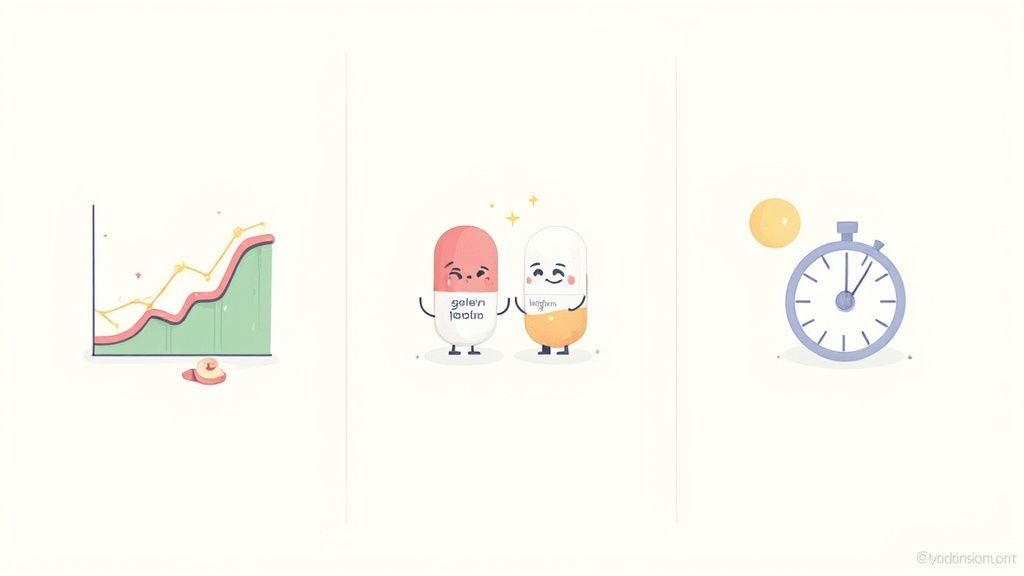
Once you understand this blueprint, you'll see that you aren’t fighting a personal flaw. You're just responding to specific, predictable biological signals—signals that can be understood and, more importantly, rewritten for good.
The Blood Sugar Rollercoaster
Think of your blood sugar as your body's fuel gauge. When it's steady, you feel great. But many of our daily habits can send that needle on a wild rollercoaster ride.
When you restrict calories too much or skip meals during the day, your blood sugar levels can tank by the evening. This deficit sends a loud and clear SOS to your brain: "Emergency! We need energy, now!" This is your primal survival instinct kicking in, completely overriding logic and demanding quick-fix foods like sugar and carbs.
On the flip side, a large, high-sugar meal can cause a massive spike followed by an equally dramatic crash. That post-dinner slump isn't just you feeling a bit tired; it's your body's fuel gauge plummeting, triggering the very same intense cravings. Getting a handle on this is crucial. You can learn more in our guide on how to stabilize blood sugar levels.
That blood sugar crash is a physiological alarm bell. The intense craving for a pint of ice cream isn't a sign of weakness—it's your brain executing a pre-programmed command to find the fastest fuel source to fix what it thinks is an emergency.
Your Hunger Hormones Ghrelin and Leptin
Your appetite isn't just a random feeling; it's a conversation managed by two key hormones. Getting to know them is essential for figuring out why cravings feel so much stronger after dark.
- Ghrelin (The "Go" Hormone): Often called the "hunger hormone," ghrelin is the one that tells your brain it's time to eat. Its levels naturally rise before meals.
- Leptin (The "Stop" Hormone): Produced by your fat cells, leptin is the messenger that tells your brain you're full and have enough energy stored away.
These hormones have their own daily rhythm. For many people, ghrelin naturally peaks in the evening right when leptin dips, creating a perfect storm for hunger. Hormonal imbalances play a huge role in nighttime eating, disrupting hunger signals when your willpower is already at its lowest.
This isn't uncommon. Globally, 0.5-1.5% of people in the general population suffer from Night Eating Syndrome (NES), a number that jumps to 3-15% in obese individuals, often driven by these hormonal shifts.
Your Internal Clock The Circadian Rhythm
Deep inside your brain, you have a master clock known as your circadian rhythm. This 24-hour cycle governs nearly everything your body does, from your sleep-wake schedule to your metabolism and, you guessed it, your hunger. It’s what tells your body when to be active and when to power down for rest.
The problem is, modern life is incredibly good at messing with this internal clock.
- Late Nights: Staying up way past your body’s natural bedtime throws your hormonal signals completely out of whack.
- Screen Time: The blue light from your phone and TV suppresses melatonin (the sleep hormone), essentially telling your brain to stay awake and active.
- Irregular Schedules: When you eat and sleep at inconsistent times, your internal clock gets confused.
When your circadian rhythm is disrupted, your body doesn't know what time it is. It might start sending out hunger signals at night when it should be winding down, making you feel hungry even when you don't need the calories. Learning more about understanding and enhancing sleep quality can be a game-changer. Getting this natural rhythm back on track is one of the most important steps in taking back your evenings.
How Your Mind Drives Late-Night Cravings
While your body’s biology can set the stage for night eating, your mind is usually the one directing the show. The link between what’s going on in your head and that late-night trip to the kitchen is incredibly strong. If you can start to understand that connection, you can finally stop fighting a battle of willpower and start addressing the real reasons you’re eating.
Think of your decision-making ability like a phone battery. You wake up with a full 100% charge. Every little choice you make—what to wear, how to answer an email, whether to grab a second coffee—drains a tiny bit of that power. By the time evening rolls around, after a day packed with hundreds of decisions, your battery is deep in the red zone.
This is what experts call decision fatigue. When your mental gas tank is empty, your brain doesn't have the energy for complex thought; it just looks for the easiest, most impulsive option available. Suddenly, resisting that pint of ice cream doesn't just feel hard, it feels nearly impossible because your mental defenses are completely down.
The Stress-Snacking Connection
Stress isn't just a feeling in your head—it triggers a very real, physical response. When you're stressed out, your body pumps out a hormone called cortisol. A little bit is fine, but chronic, day-in-day-out stress keeps those cortisol levels cranked up, which directly sparks cravings for fatty, sugary foods.
What's happening is your brain is screaming for a quick dose of pleasure and comfort to take the edge off the stress. Those calorie-dense "comfort foods" deliver a temporary surge of feel-good chemicals, making them a very effective (though very temporary) emotional band-aid.
"If you consistently find yourself in the pantry after a tough day, you're not just 'giving in.' You're responding to a biological command from cortisol to self-soothe. This isn't a moral failing; it's a misguided coping mechanism."
This is why things like evening anxiety and depression are such powerful drivers of nighttime binging. The link is so tight that people with Night Eating Syndrome (NES) often have much higher rates of depression. While NES only affects about 1-4.6% of people overall, that number skyrockets in high-stress populations, proving just how much our mental state can dictate our eating habits. You can read the full research about these correlations to see how deep this connection truly runs.
What Are Your Emotional Triggers?
Beyond the hard science of hormones, our day-to-day feelings play a massive role. Once the house is quiet and the distractions of the day fade, the emotions we’ve been pushing down all day have a tendency to bubble up to the surface. We're left alone with our thoughts, and food often becomes the go-to solution.
Some of the most common emotional triggers for night eating are:
- Boredom: When there’s nothing else going on, eating becomes an activity—something to do.
- Loneliness: Food can feel like a friend, temporarily filling a void when you feel isolated.
- Anxiety: The simple, repetitive motion of chewing can be surprisingly calming for a worried mind.
- Procrastination: Grabbing a snack is a classic way to put off a task you’re dreading or a thought you don't want to confront.
This is a classic pattern of emotional eating, where food is used to manage feelings instead of satisfying actual, physical hunger. Recognizing this pattern is the first crucial step. For a much deeper look, check out our guide to help you stop emotional eating. Once you can name your triggers, you can start finding healthier ways to cope when those feelings show up.
Actionable Strategies to Reclaim Your Nights
Knowing why you binge at night is half the battle. Now, let’s get into the other half: taking action. Think of this as your practical toolkit, packed with real-world strategies to help you take back your evenings, starting tonight.
Each tactic here is designed to tackle the root causes we just covered. This isn't about finding a magic cure, but about making small, deliberate changes to your day that make a huge difference when the sun goes down.
Balance Your Daytime Meals
Honestly, one of the best ways to stop a nighttime binge is to prevent it hours before it even starts. If you skimp on food during the day, your body hits the evening running on fumes. That’s when the primal, can't-ignore-it hunger signals take over.
The fix is to focus on building balanced, satisfying meals throughout the day. This isn't about restriction; it's about giving your body the steady energy it needs to avoid that nighttime crash and burn.
- Prioritize Protein: Make sure every meal has a solid protein source like chicken, fish, beans, or tofu. It keeps you feeling full and satisfied for much longer because it slows down digestion.
- Fill Up on Fiber: Veggies, whole grains, and fruits are your best friends here. They add bulk to your meals and, most importantly, help keep your blood sugar from going on a rollercoaster ride. No dramatic spikes and crashes means fewer intense cravings later.
- Don't Fear Healthy Fats: Foods like avocado, nuts, and olive oil also play a huge role in satiety. They help you feel genuinely satisfied with your meals, which is key.
Think of it like this: a well-fueled day leaves no room for a frantic, hungry night.
Master Your Stress
Let’s be real: your mental state has a massive say in your eating habits. Stress, anxiety, and just plain old end-of-day exhaustion drain your willpower and turn up the volume on cravings for comfort food.
This diagram shows exactly how those mental triggers can drive us to the kitchen late at night.
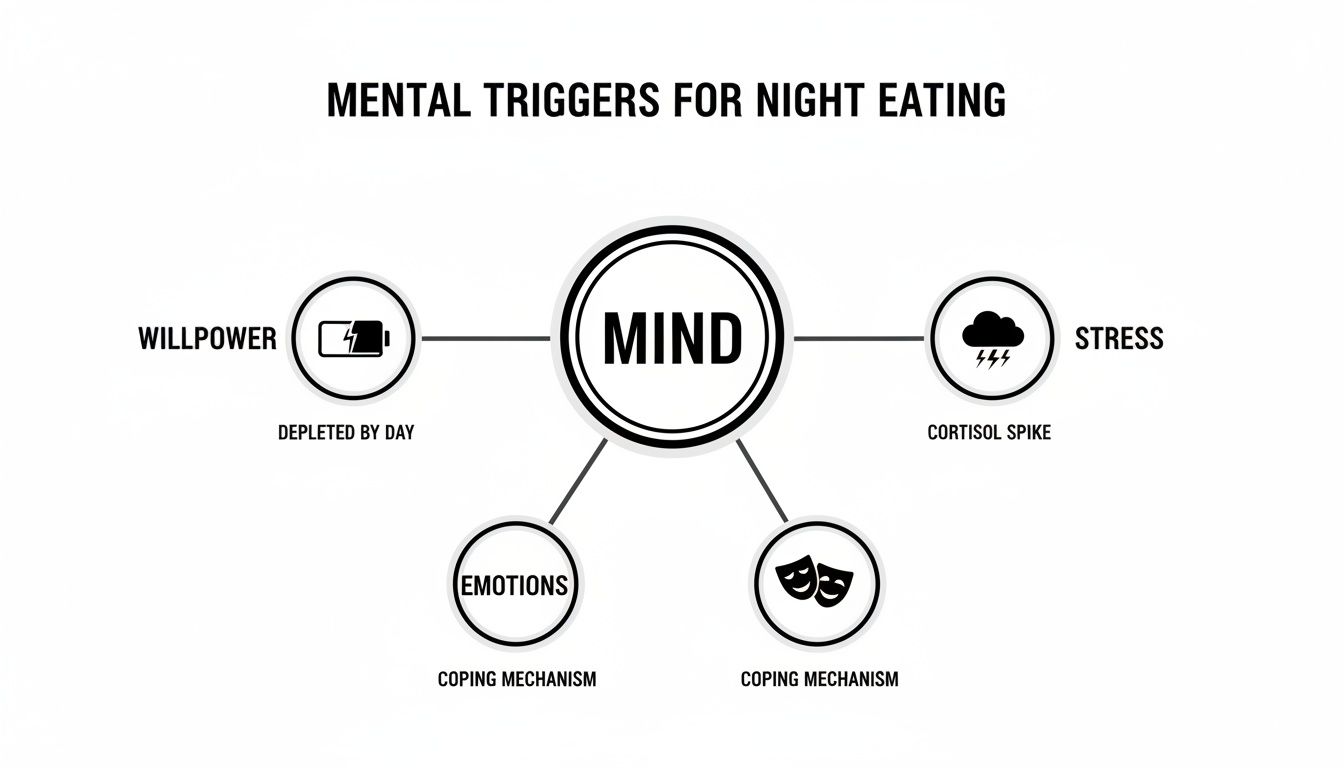
When your willpower battery is low, stress and tough emotions create the perfect storm for a binge. The trick is learning to handle these feelings before they send you to the pantry. It's about building a new toolkit of stress-busters that don't involve food.
- Practice Mindful Moments: Seriously, just five minutes of deep breathing can calm your entire nervous system and lower cortisol. The next time an urge hits, pause. Take ten slow, deep breaths before you make a move.
- Journal Your Thoughts: Getting your feelings onto paper can be a huge release. Spend a few minutes before bed just jotting down whatever’s on your mind. It helps you process the day without eating over it.
- Gentle Movement: You don't need a full workout. A short evening walk or some light stretching can do wonders to release all the tension that's built up.
Finding a healthy way to unwind isn't a luxury; it's a necessity. It’s about replacing the habit of "stress-eating" with the practice of "stress-soothing."
Re-Engineer Your Environment
Your environment is a powerful, silent influence on your habits. If your kitchen is a 24/7 temptation zone, you're constantly fighting an uphill battle using willpower that's already worn out from the day. A few simple tweaks can make healthy choices easy and binges harder.
This is all about setting up your space to support your goals, not sabotage them.
- Make Healthy Foods Visible: Keep a bowl of fresh fruit on the counter. Put pre-cut veggies right at eye level in the fridge. When a good option is the first thing you see, you're far more likely to grab it.
- Create Friction for Binge Foods: Move the tempting stuff out of sight. Put cookies in an opaque container on a high shelf or way in the back of the pantry. That little bit of extra effort can be all you need to pause and rethink your choice.
- Design a Calming Nighttime Routine: A consistent ritual signals to your brain and body that it's time to wind down for sleep. This could be a warm bath, reading a book (a real one!), or listening to calming music. A solid routine helps regulate your internal clock and makes late-night snacking less likely.
Getting better sleep is fundamental to this whole process. For a deep dive into improving your rest, check out these proven techniques for natural and restful sleep. By creating a peaceful evening ritual, you tackle both the environmental and biological triggers at the same time.
How Modern Tools Can Support Your Journey
Knowing why you eat late at night is a huge first step, but actually changing those habits in the real world? That can feel like a whole different battle. This is where the right tools can be a game-changer, acting as a supportive partner when you need it most. You don't have to go it alone or rely on sheer willpower—technology can provide the structure and in-the-moment guidance to help you break free from old patterns.
An app like StopSugar is built specifically to help you put all these strategies into practice. It’s one thing to know your triggers, but it's another to have a tool that helps you spot and manage them as they happen, making real change feel much more possible.
Building Awareness and Interrupting the Cycle
The first step to changing any habit is simply noticing it. So many of us eat at night on autopilot, not even realizing what emotions are driving us until the empty wrappers are already there. Digital tools can shine a light on these unconscious patterns, creating a critical pause between the urge and the action. That small gap is where you find the power to choose something different.
This is especially true for people dealing with Night Eating Syndrome (NES), a major cause of nighttime binges that affects about 1.5% of the population. This disorder, where someone eats at least 25% of their daily calories after dinner, shows just how ingrained these habits can become. Among people seeking weight loss surgery, that number can jump to anywhere between 6% and 64%. You can learn more about these findings on NES and see why structured support is so important.
A tool like StopSugar helps you build this self-awareness through simple, consistent actions.
- Daily Check-ins: These quick prompts get you to connect your mood with your cravings. When you log how you feel, you start seeing the direct lines between stress, boredom, or sadness and your urge to eat. This tackles the emotional triggers head-on.
- The Panic Button: Think of this as your emergency brake for when a craving feels overwhelming. It offers immediate, guided distractions—like a quick breathing exercise or a simple game—to help you ride out the urge without caving.
Technology can’t make your challenges disappear, but it can give you a concrete action to take when you feel powerless. Hitting a button is a lot easier than fighting an intense craving with nothing but willpower.
Finding Practical, Healthy Alternatives
Breaking a habit isn't just about stopping something; it's about replacing it with something better. But when you’re tired and stressed, trying to brainstorm a healthy alternative to your go-to binge foods feels impossible. This is another spot where a good app can take the pressure off.
The 'Alternatives' feature in StopSugar gives you a whole library of healthy swaps and coping strategies right when you need them. Instead of automatically reaching for the ice cream, you get instant ideas for healthier snacks or even non-food activities to manage your feelings.
Combining a tool like this with insights from the best habit tracking apps can create a really powerful system for building new routines. And with future developments like an AI coach, this support will become even more personalized, offering advice based on your unique patterns to help you finally find those peaceful, binge-free evenings.
Putting It All Together: Your Plan for Peaceful Evenings
Alright, we've untangled the science behind why you eat at night and the habits that keep the cycle going. Now for the most important part: turning that knowledge into a real, practical plan that works for you.
This is where you start building a new routine and finally find some peace in your evenings.
But first, a crucial reminder: be kind to yourself. This isn't about flipping a switch overnight. Some nights will be harder than others, and that's completely normal. The goal here is progress, not perfection. Every small step forward is a win.
Your Simple Action Plan
Instead of trying to fix everything at once (a recipe for burnout), let's focus on a few small, deliberate changes. This is how you build momentum and create new habits that actually last.
Here’s a simple, three-step blueprint to get you started this week. The only rule is to be honest and pick things that feel genuinely doable for your life.
- Step 1: Name Your Top Triggers Think about the last couple of weeks. What were the top three situations, feelings, or times of day that sent you to the kitchen? Was it work stress hitting you at 9 PM? Boredom after the kids went to bed? Or just feeling ravenous because you skipped lunch? Get specific and write them down.
- Step 2: Pick One Food Tweak Don't try to revamp your whole diet. Just choose one thing to try this week. Maybe it's making sure you have a solid source of protein with every meal to feel fuller, longer. Or maybe it's planning a satisfying, healthy snack you can look forward to in the evening.
- Step 3: Choose One New Coping Tool When those triggers pop up, what will you do instead of eating? Pick one non-food coping strategy to have in your back pocket. It could be a five-minute breathing exercise when you feel that familiar stress, or ten minutes of journaling before you climb into bed.
Think of this plan as your personal roadmap. It isn't about rigid rules. It's about learning your own patterns and meeting your needs with intention and a little self-compassion.
You absolutely can break the cycle of nighttime binge eating. You now understand what’s happening in your body and mind, and you have the tools to start writing a new story. By taking these small, consistent steps, you're on your way to a future where your evenings are calm and you feel in control.
You can do this.
Common Questions About Nighttime Eating, Answered
Even after understanding the why behind nighttime eating, you probably still have a few questions rolling around in your head. That's completely normal. Let's clear up some of the most common ones I hear.
Is It Bad to Eat at Night if I’m Genuinely Hungry?
Absolutely not. There's a world of difference between true, physical hunger and a binge that’s fueled by habit or emotion. If your stomach is genuinely growling because dinner was early or you had a killer workout, a small, balanced snack is a great idea.
The trick is to learn to read your body’s signals honestly. A binge usually feels urgent, chaotic, and almost out of your control—you keep eating long after you're physically full. On the other hand, mindfully eating a snack to satisfy real hunger is just you taking care of yourself.
What’s the Deal With Night Eating Syndrome (NES)?
This is a great question because it helps separate a tough habit from a clinical condition. Night Eating Syndrome (NES) isn't just about having the late-night munchies; it's a diagnosable disorder. It's defined by a pattern where someone eats 25% or more of their daily food intake after the evening meal.
People with NES typically have zero appetite in the morning but feel an overwhelming compulsion to eat at night, sometimes even waking up from sleep to do so. If this feels uncomfortably familiar, it’s really important to talk to a doctor or therapist. NES often goes hand-in-hand with conditions like depression and anxiety.
Knowing the difference between a habit and a disorder is key. Many of us fall into nighttime binging because of stress or dieting. NES, however, is a deeper issue involving a real disruption to your body's internal clocks and appetite signals.
Will I Automatically Gain Weight if I Eat Before Bed?
That old myth about not eating after 7 p.m.? It's just not based on how our bodies actually work. Your metabolism doesn't just clock out for the night. When it comes to weight, what truly matters is your overall calorie balance throughout the entire day, not the time you eat.
The real problem is why we eat at night. Binge eating sessions usually involve foods that are high in calories but low in nutrients, which makes it incredibly easy to eat more calories than you burn, leading to weight gain. A small handful of almonds to quiet a rumbling stomach is a completely different story than a pint of ice cream eaten out of stress.
Instead of obsessing over the clock, try to focus on why you’re reaching for food and what you’re choosing. Once you start tackling the root causes we've talked about, the kind of nighttime eating that leads to weight gain often takes care of itself.