Agave Nectar vs Sugar A Healthier Sweetener?

When it comes to sweeteners, the agave vs. sugar debate always circles back to one big question: is agave actually healthier?
Let's cut right to the chase. The simple answer is no, agave nectar is not a healthier choice than sugar. While it has a lower glycemic index, its alarmingly high fructose content creates serious metabolic problems, especially for your liver.
Decoding the Sweetener Debate
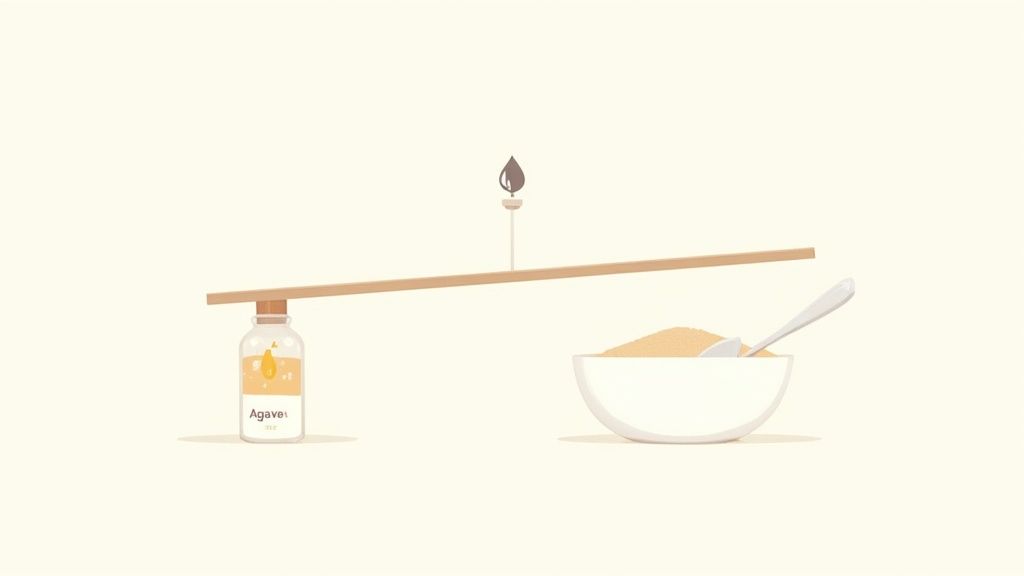
On the surface, agave nectar and table sugar look completely different. One is a liquid syrup from a plant, often marketed as a natural alternative. The other is the classic white crystal we all know. But don't let appearances fool you. They are both caloric sweeteners, and once they're processed, they break down into simple sugars.
This guide will take you beyond the marketing hype to give you a clear, science-backed look at agave nectar versus sugar. We’ll break down how your body processes each one, uncover their surprising chemical differences, and explore the real-world impact on everything from your blood sugar to your liver. It's time to get the facts.
Key Differences at a Glance
Let's start with a side-by-side comparison of the most important factors. This table gives you a quick snapshot before we get into what these numbers really mean for your health.
| Feature | Agave Nectar | Table Sugar (Sucrose) |
|---|---|---|
| Glycemic Index (GI) | Very Low (Approx. 17) | Moderate (Approx. 63) |
| Main Sugar Type | High Fructose (70-90%) | Balanced (50% Fructose, 50% Glucose) |
| Calories (per tsp) | ~21 calories | ~16 calories |
| Form | Liquid Syrup | Granulated Crystal |
| Sweetness Level | ~1.5x sweeter than sugar | Standard sweetness |
This comparison reveals the core trade-off. Agave’s low glycemic index is the main reason it became so popular, and it has fueled major market growth. In fact, the global agave nectar market was valued at USD 174.0 million in 2023 and is expected to hit USD 257.3 million by 2030, mostly because of its appeal to people trying to manage blood sugar. You can read more about this trend and market projections.
But as you're about to see, a low GI doesn't tell the whole story. Not even close.
Comparing Nutritional and Chemical Profiles
To really get to the bottom of the agave vs. sugar debate, we need to look past the marketing and dive into what they're actually made of. While they both taste sweet, their chemical makeup is fundamentally different, which completely changes how your body processes them. It all boils down to two simple sugars: glucose and fructose.
Table sugar, which you probably know as sucrose, is pretty straightforward. It’s what scientists call a disaccharide, meaning it's just two sugar molecules stuck together: one glucose and one fructose, in a perfect 50/50 split. When you eat it, your body easily breaks them apart, and they head off to do different jobs.
Agave nectar, on the other hand, is a whole different story. It's not balanced at all. In fact, it's incredibly high in fructose—some brands can be as much as 90% fructose. This lopsided ratio is the single most important thing to understand in this entire comparison.
A Side-by-Side Breakdown
To see how these two stack up in the real world, let's look at the numbers. They tell a much clearer story than you might get from a product label.
Nutritional Snapshot: Agave Nectar vs. Table Sugar (Per Tablespoon)
Here's a quick look at how a tablespoon of each sweetener compares nutritionally. The differences might surprise you.
| Nutrient | Agave Nectar | Table Sugar |
|---|---|---|
| Calories | ~60 | ~48 |
| Total Carbohydrates | ~16g | ~12g |
| Fructose Content | ~70-90% | 50% |
| Glucose Content | ~10-30% | 50% |
As you can see, agave nectar actually packs more calories and carbs per tablespoon. This is mainly because it’s a dense liquid, while granulated sugar has tiny pockets of air between the crystals. If you want to get better at spotting these kinds of details, learning the basics of understanding ingredient labels is a great place to start.
The table makes it clear that the most significant difference isn't the calorie count, but where those calories come from—specifically, the type of sugar.
The Fructose Factor: The real story here isn't about calories; it's about composition. Agave's massive fructose load is the reason it behaves so differently from table sugar, affecting everything from your blood sugar to how your liver works.
Because agave can be around 80% fructose, it has a low glycemic index—fructose doesn't cause a direct spike in blood glucose levels. This might sound like a good thing. For example, some short-term studies on mice found that those given agave nectar gained less weight and had lower blood sugar than those given sucrose.
But this is where things get tricky. While avoiding a blood sugar spike seems like a clear win, the way your body is forced to handle that huge wave of fructose comes with its own set of problems, which we'll get into next.
The Glycemic Index Deception
On paper, agave nectar's biggest draw is its remarkably low glycemic index (GI). It scores around 17, which barely registers on blood glucose levels. Compare that to table sugar, which has a more moderate GI of 63. Based on this number alone, agave looks like the clear winner for anyone trying to manage their blood sugar.
Because of its low GI, agave doesn't create the immediate blood glucose spike—and the insulin rush that follows—like regular sugar does. This is exactly why it's often marketed as a "diabetic-friendly" or "healthy" sweetener. But that's a dangerously incomplete picture.
The glycemic index only tells you how a food affects your blood glucose right after you eat it, not the whole story of how your body processes it. If you want to dive deeper, our guide explains what the glycemic index is and what it really means for your health.
The Hidden Cost of a Low GI
So, why does agave have such a low GI? It comes down to its chemical makeup. Agave is packed with fructose, a sugar that bypasses the bloodstream and takes a direct, non-stop flight to your liver for processing.
This infographic lays out the key nutritional differences, and that fructose percentage is the real kicker.

As you can see, while the calorie count is similar, the fructose concentration in agave is off the charts.
You might sidestep the immediate glucose spike with agave, but you’re trading it for a fructose flood that slams your liver. This is the central deception of using the glycemic index as your only measure of a sweetener's health.
This metabolic detour creates its own set of serious problems. When the liver gets hit with more fructose than it can handle, it starts converting the excess into fat, namely triglycerides. This process can kick off a chain reaction of long-term health issues that are far worse than a temporary blood sugar bump. We'll get into exactly how that works next.
How Your Body Processes Agave and Sugar
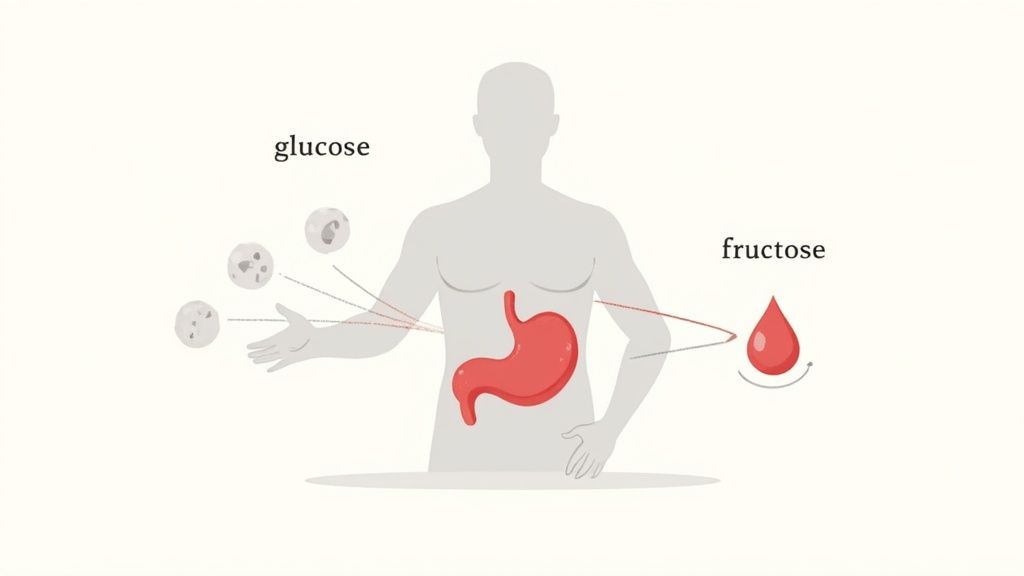
To really understand the agave versus sugar debate, we need to look past the marketing and see what happens inside your body. It's not about calories—it’s about the completely different ways your body handles each one.
When you eat table sugar (sucrose), your body breaks it down into a neat 50/50 mix of two simpler sugars: glucose and fructose.
Glucose is your body's go-to fuel. Think of it as premium gasoline for your cells. From your brain to your muscles, almost every part of you can use glucose for instant energy. It enters your bloodstream, your body releases a bit of insulin to help your cells absorb it, and you're good to go. It's a clean, efficient system.
The Fructose Overload Problem
Fructose, on the other hand, is a bit of a specialist. It takes a detour. Unlike glucose, most of your cells can't use it directly, so it gets shipped off almost exclusively to one place: your liver.
Now, a little bit of fructose is no big deal. The amount you get from an apple, for example, is easily managed. The fruit's fiber slows everything down, and your liver can handle it just fine.
But agave nectar is a different beast entirely. With a fructose content that can be as high as 90%, it sends a massive, unnatural flood of fructose straight to your liver, overwhelming its processing capacity. The catch is that fructose doesn't trigger much of an insulin response. That might sound like a win, but it means there’s no hormonal "off-switch" telling your brain you're full. If you want to dive deeper, our article explains what causes insulin spikes and why that signal is so crucial for your health.
When your liver gets hit with that much fructose at once, it’s forced to do something with it. Its main option is to convert the excess into fat through a process called de novo lipogenesis.
In plain English, your liver starts turning all that extra fructose from agave into triglycerides (a type of fat). This new fat can get stored right there in the liver, laying the groundwork for serious health issues down the road.
This is the hidden danger of agave. The very thing that gives it a low glycemic index—its sky-high fructose content—is precisely what makes it a long-term threat to your metabolic health.
Long-Term Health Consequences
This constant fat production in your liver isn't something to ignore. Over time, it can trigger a domino effect of health problems that make a temporary blood sugar spike look trivial.
Here are some of the key risks tied to high fructose consumption:
- Non-Alcoholic Fatty Liver Disease (NAFLD): This is exactly what it sounds like—excess fat builds up in the liver, which can lead to inflammation and serious damage.
- Increased Visceral Fat: This is the dangerous fat that wraps around your internal organs. It’s a major driver of metabolic syndrome.
- Insulin Resistance: Even though fructose doesn't spike insulin directly, overloading the liver with it can make the liver resistant to insulin's effects—a huge step toward type 2 diabetes.
- Elevated Triglycerides: High levels of these fats circulating in your blood are a well-known risk factor for heart disease.
At the end of the day, while table sugar certainly has its own problems, its balanced glucose-fructose mix is handled by your entire body. Agave, in contrast, puts a unique and intense strain squarely on your liver, making its "healthy" reputation deeply misleading.
Using Agave and Sugar in the Kitchen

Putting the health debate aside, the real question for many of us is: how do agave and sugar actually behave in the kitchen? Their differences go far beyond nutrition. From sweetness level to their physical form—liquid versus solid—choosing the right one can make or break your recipe.
The first thing to know is that agave nectar is much sweeter than table sugar, about 1.4 to 1.5 times sweeter, in fact. This means you can get away with using less. But since it's a liquid, it also adds moisture, which can be a game-changer, for better or for worse.
When to Choose Agave Nectar
Agave’s liquid form is its biggest strength in certain situations. It dissolves instantly, even in cold drinks, so you'll never have that gritty sugar sludge at the bottom of your iced tea again.
Reach for agave when you're making:
- Beverages: It’s a no-brainer for sweetening iced coffee, cocktails, and smoothies smoothly and evenly.
- Sauces and Marinades: It blends right into salad dressings, BBQ sauces, and glazes without affecting the texture.
- Moist Baked Goods: If you want soft, chewy brownies or muffins that stay fresh longer, agave is your friend. It helps lock in moisture.
Key Takeaway: The high fructose content in agave means it browns much faster than sugar. When baking with it, a good rule of thumb is to lower your oven temperature by about 25°F (15°C) to keep the outside from burning before the inside is fully cooked.
When Sugar Is the Better Choice
For all its benefits, agave just can't do what granulated sugar does for structure and texture. In many recipes, sugar is a key building block, not just a sweetener.
Stick with table sugar for:
- Crisp Textures: Think shortbread cookies or biscotti. That classic snap and crunch comes from sugar crystals, something a liquid just can’t replicate.
- Creaming with Butter: Beating butter and sugar together creates tiny air pockets that give cakes and cookies a light, airy crumb. This is a crucial step for leavening that you'll miss with agave.
- Caramelization: Agave browns, but sugar truly caramelizes. It develops that deep, nutty, and complex flavor essential for things like caramel sauce or crème brûlée. This is also why using dark brown sugar in recipes is so effective for achieving a specific molasses-rich flavor.
Figuring out how to swap one for the other takes a bit of practice. If you need some specific conversion ratios and tips, our guide on how to substitute agave for sugar walks you through it. At the end of the day, deciding between agave and sugar isn't just about health—it’s very much a culinary choice.
Which Sweetener Is Right for You?
https://www.youtube.com/embed/GMhn0tA52Ho
So, after all that, what’s the final verdict in the great agave vs. sugar debate? It really boils down to your personal health goals and what you’re using it for. There’s no simple “healthier” option here—just the one that lines up better with your specific priorities at a given moment.
Think of it as a strategic choice. If your main goal is to sidestep a big blood sugar spike, agave’s low glycemic index gives it a clear short-term edge over regular table sugar.
But that advantage comes with a serious trade-off. If you're more concerned about long-term liver health, keeping your triglycerides in check, or lowering your risk for metabolic syndrome, agave's extremely high fructose content makes it the riskier pick.
Making the Decision Based on Your Goals
To break it down, let's look at a few common scenarios. This should help you get past the "good vs. bad" thinking and choose the right tool for the job. Just remember, with either one, less is always more.
- For Managing Blood Sugar: Someone with diabetes might find that a tiny drop of agave in their tea helps them avoid a sharp glucose spike. The key words here are tiny drop, because the long-term effects of all that fructose are still a real concern.
- For Protecting Liver Health: If you’re already worried about things like fatty liver disease or high triglycerides, table sugar is arguably the lesser of two evils. Of course, the best strategy is to cut way back on both.
- For Baking and Cooking: Here, the choice often comes down to what you’re making. Sugar is what gives cookies that classic crisp structure, while agave’s moisture content is perfect for making brownies dense and chewy.
The most important thing to remember is that both agave and table sugar are just added sugars. From a health perspective, the real win isn't swapping one for another—it's reducing how much of any caloric sweetener you consume.
Looking Beyond Agave and Sugar
Ultimately, the smartest play for your long-term health is to start exploring alternatives that give you sweetness without the metabolic downside. Sweeteners like stevia and monk fruit are fantastic choices because they’re zero-calorie and don't mess with your blood sugar or insulin levels.
When you're using the StopSugar app, you can track your intake of agave and sugar to see how they personally affect your energy and mood. The app is also a great resource for discovering and slowly transitioning to healthier substitutes, which can help you finally break free from added sugars altogether.
Frequently Asked Questions
It’s easy to get lost in the world of sweeteners. Let's clear up some of the most common questions about agave and sugar so you can feel more confident about your choices.
Is Agave Nectar Better Than High-Fructose Corn Syrup?
Honestly, when it comes to how your body processes them, they're practically twins. Both agave nectar and high-fructose corn syrup (HFCS) are loaded with fructose. Agave might have a healthier reputation, but your liver can't tell the difference—it treats the high fructose load from both sweeteners in the exact same way.
The Verdict: Neither one is a health food. The intense fructose concentration in both puts a lot of stress on your liver. It’s best to use either of them sparingly, if at all.
Can I Use Agave Nectar If I Have Diabetes?
This one is tricky. On one hand, agave's low glycemic index is a definite plus because it won't spike your blood sugar like table sugar does. For short-term glucose management, that can be helpful.
But the long-term story is different. All that fructose can harm your liver, raise triglycerides, and even contribute to insulin resistance over time. It's absolutely essential to talk to your doctor or a registered dietitian to see if a tiny amount can safely fit into your diet.
Does Agave Nectar Cause Weight Gain?
Any sweetener with calories can lead to weight gain if you overdo it. In fact, agave nectar has more calories per tablespoon (~60) than table sugar does (~48).
While some studies hint that agave might cause less initial weight gain than sucrose, the way fructose encourages fat storage, especially in the liver, can sabotage long-term weight goals. The best strategy for managing your weight is to cut back on all added sugars—and that includes both agave and table sugar.