Habit Formation Psychology to Finally Beat Sugar Cravings
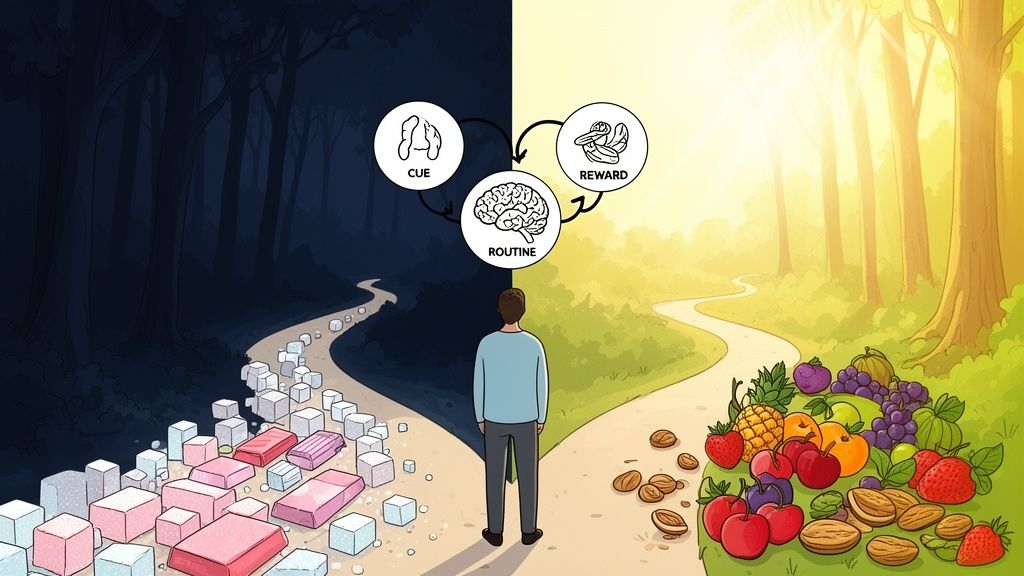
Habit formation psychology is simply the study of how our brains wire themselves to perform actions on autopilot. It’s a fascinating field that shows us how much of our daily life isn't about conscious choice at all, but about these mental shortcuts our brain creates to save energy. Once you grasp this, you hold the key to breaking bad habits—like reaching for sugar—and building better ones in their place.
Why Willpower Is Not Enough to Quit Sugar
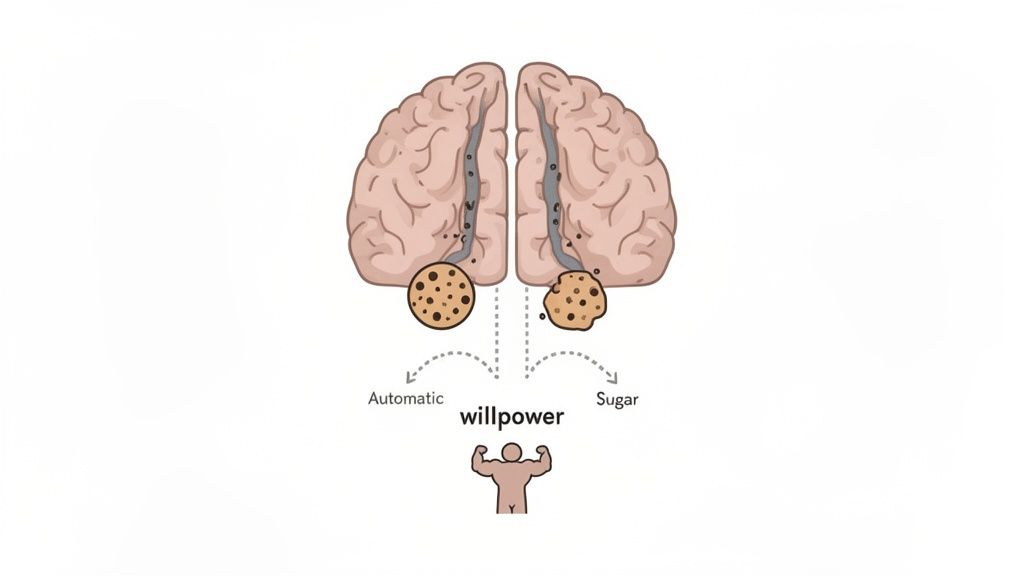
If you've ever declared "no more sugar" in the morning only to find yourself hunting for a cookie by 3 p.m., you've experienced a universal truth: willpower is a terrible long-term strategy. It feels like a personal failure, but it’s not. It's just a predictable outcome of how our brains are wired. Your mind is built for efficiency, and habits are its ultimate energy-saving hack.
Think of your brain like a vast, grassy field. The first time you do something, like eating a donut when you feel stressed, you trample down a faint path. Do it again tomorrow, and the path gets a little clearer. Keep repeating it, and soon you've carved out a deep, wide highway. Given the choice, your brain will always take the smooth, easy highway over hacking a new trail through the tall grass.
The Power of Automatic Actions
This is precisely why your sugar habit feels so automatic. It’s not really a conscious choice you’re making every single time. It’s a default program that runs the moment a specific cue appears, whether that's stress, boredom, or even just the time of day. You aren't just fighting a fleeting desire; you're up against a deeply ingrained neurological reflex.
In fact, research has found that nearly 43% of our daily actions are performed automatically while our minds are thinking about something else entirely. This kind of "context-dependent automation" is exactly why a certain feeling or place can trigger a powerful sugar craving before your willpower even has a chance to step in. You can learn more about the science behind our daily habits and why they feel so out of our control.
The core insight of habit formation psychology is this: Instead of fighting the old path with sheer force, you must strategically build a new, more appealing one. You don't break habits; you replace them.
Shifting from Willpower to Strategy
The common approach to quitting sugar relies on willpower—a finite resource that runs out. A better way is to focus on the underlying psychology of the habit itself.
This table shows the difference between the two approaches:
Willpower vs Habit Psychology for Quitting Sugar
| Approach | Focus | Common Outcome | Psychological Principle |
|---|---|---|---|
| Willpower-Based | Resisting temptation through sheer mental force. | Burnout, frustration, and feeling like a failure when cravings win. | Views habit as a moral or personal failing. |
| Psychology-Based | Understanding and redesigning the habit loop (cue, routine, reward). | Sustainable change, less internal conflict, and building a new default behavior. | Views habit as a learned, automatic neural pathway. |
By understanding the mechanics behind your habits, you can stop fighting a losing battle of willpower and start playing a winnable game of strategy.
It's about identifying the specific triggers that send you down that sugary highway and then consciously paving a different route. This guide will show you how to become an architect of your own habits, using proven psychological principles to create new, healthier pathways that eventually become the easiest choice.
Understanding the Three-Part Habit Loop
Every habit you have, good or bad, runs on a simple, invisible script in your brain. Psychologists call this the habit loop, and it’s the engine driving all of your automatic behaviors, from brushing your teeth to reaching for a sugary snack. It’s a three-part cycle that runs so smoothly, you often don't even notice it's happening.
Once you learn to spot this pattern in your own life, you’re no longer a passenger. You can start to deconstruct the machinery behind your sugar cravings and build something better in its place.
The Cue: The Initial Trigger
It all starts with a cue. Think of the cue as the starting gun for a race. It’s the trigger that tells your brain to switch into autopilot and run a specific habit program. These triggers can be almost anything.
- Time of day: That classic 3 p.m. energy dip.
- A place: Walking past the office kitchen and seeing the donut box.
- An emotion: Feeling stressed, bored, or even celebratory.
- Other people: Being with friends you always grab dessert with.
- A preceding action: The moment you finish a savory meal.
Let’s say your cue is that mid-afternoon fatigue. Your brain senses it and immediately knows which well-worn path to take to "solve" the problem. The entire process kicks off without a single conscious thought.
The Routine: The Automatic Behavior
Next up is the routine—the action itself. This is the part we tend to focus on, but it’s just the middle step. It’s the physical or mental behavior you perform in response to that cue.
Following our example, the routine is the act of getting up from your desk, walking to the vending machine, and buying a candy bar. It feels almost effortless because you’ve done it so many times. Your brain has paved a neural superhighway for this behavior, so you just do it. No real decision-making required.
The Reward: The Brain’s Payoff
Finally, the loop closes with the reward. This is the prize your brain gets for its hard work, and frankly, it's the entire reason the habit exists. The reward tells your brain, "Hey, that worked. Let's remember to do that again next time."
When you eat that candy bar, you get a quick jolt of energy from the sugar and a satisfying rush of dopamine, the brain's "feel-good" chemical. That pleasant sensation is a powerful signal. It teaches your brain that when the 3 p.m. slump (the cue) hits, grabbing sugar (the routine) is a fantastic solution.
This cue-routine-reward cycle gets stronger and more automatic every time you complete it. The reward isn't just about feeling good; it's a deep learning mechanism that cements the behavior into your brain.
To really get why this is so powerful, it helps to look at the brain chemistry involved. The deep-seated link between Dopamine and Motivation explains why some rewards feel almost impossible to resist. Over time, this can even lead to what feels like a dependency; you can learn more about the signs of dopamine addiction here.
The secret to breaking a bad habit isn’t about brute force or fighting the cue. It's about consciously choosing a new routine that delivers a healthier, yet still satisfying, reward.
How Long It Really Takes to Build a New Habit
One of the stickiest myths out there is that it takes just 21 days to build a new habit. It’s a nice, tidy number that sounds encouragingly simple, but the truth is a lot more complicated. Getting a real handle on how long it actually takes is key to setting yourself up for success, not disappointment.
That "21-day" rule? It wasn't based on hard science. It was an offhand observation from a plastic surgeon in the 1960s, Dr. Maxwell Maltz, in his book Psycho-Cybernetics. He simply noticed it took his patients about that long to get used to their new faces.
Modern research tells a much different story. A major study from University College London followed 96 people for 12 weeks as they tried to form new habits like drinking more water or going for a daily run. On average, it took 66 days before the new behavior felt like second nature.
But here’s the most important part: the range was huge. Some people locked in their new habit in as little as 18 days, while for others, it took a whopping 254 days.
Why Consistency Matters More Than Time
So, what does this mean for your quest to cut out sugar? It means you have to give yourself some grace. There is no magic number. Your personal timeline depends on the habit you're building, your environment, and your own unique psychology.
- Simple Habits: Something like a daily check-in on the StopSugar app might feel automatic pretty quickly, maybe even close to that 18-day mark.
- Complex Habits: Overhauling your entire approach to grocery shopping and cooking to avoid hidden sugars? That's a much bigger lift and will naturally take far longer to become routine.
The real takeaway here is that every single time you repeat a new behavior, you're strengthening the neural pathways in your brain. Missing one day doesn't erase all your hard work. Think of it like forging a path in a dense forest—if you don't walk it for one day, the trail doesn't just vanish. You just need to get back on it.
Consistency beats perfection every single time. The goal isn't to be flawless. It's simply to make the healthier choice more often than not. Each time you do, you're casting a vote for the new you.
This is where understanding the psychology behind habits becomes so powerful. Every habit, good or bad, is driven by a simple but powerful cycle: Cue -> Routine -> Reward.
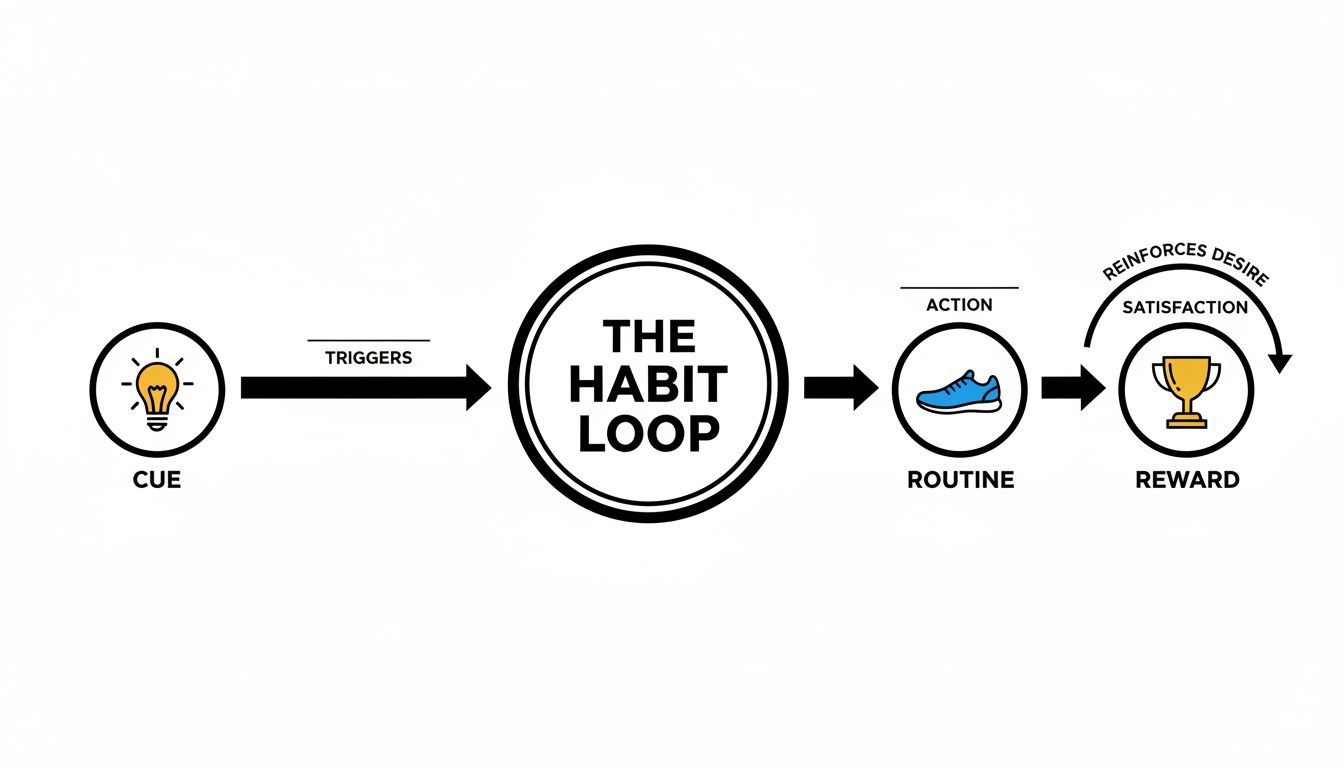
When you see how this loop works, you can start to hack it. You can identify your cue, change the routine (eating sugar), and find a new, healthier reward that still satisfies the craving. This is infinitely more effective than trying to muscle through with sheer willpower. For a little extra help staying on track, take a look at our review of the best habit tracking apps.
Designing Your Environment for Success
Let’s be honest: true, lasting change has very little to do with ironclad willpower. It’s much more about smart design. The single biggest factor in your daily choices—and the one we most often overlook—is your environment. Study after study in habit formation psychology shows that we are products of our surroundings. Your brain is wired for efficiency; it will always take the path of least resistance.
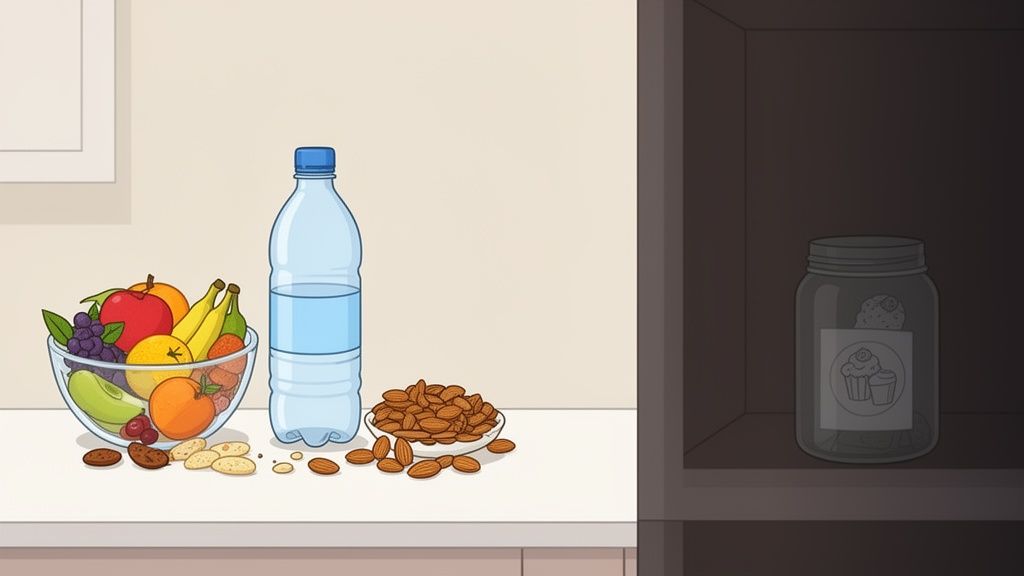
So, instead of draining your mental energy trying to fight temptation all day, you can become the architect of your own world. The goal is simple: make the healthy choice the easiest choice. Make the unhealthy one a total pain. This simple shift sets you up for success without relying on a willpower reserve that will inevitably run out.
Add Friction to Your Unwanted Habits
The secret is to add "friction" to your sugar habit. Think of friction as anything that makes a behavior just a little bit harder to do. If grabbing a cookie requires a few extra steps, you’re far less likely to do it on autopilot.
Here are a few ways to add that friction:
- Out of Sight, Out of Mind: The easiest win? Don't keep sugary junk in the house. If you live with others, store their snacks in an opaque container on a high shelf or way in the back of the pantry.
- Change Your Route: Does your daily drive take you right past that amazing bakery? Find a new way home. By removing the visual cue, you stop the craving before it even starts.
- Create a Pause: Put a sticky note on the snack cabinet that asks, "Am I actually hungry?" That tiny interruption is often all it takes to break the spell of an automatic habit.
"Habits are deeply ingrained patterns shaped by both our environment and how our brains learn over time. We form habits through rewards and consistent repetition, not just willpower."
By adding these small hurdles, you force a moment of conscious thought. That brief pause is your golden opportunity to pivot to a better choice, turning a mindless action back into a deliberate decision.
Make Good Habits Effortless
On the flip side, you want to remove every possible obstacle between you and your good habits. Make your healthy choices so easy they’re almost impossible not to do. When the good option is also the easy option, your brain will naturally gravitate toward it.
Try these simple environmental tweaks:
- Prep in Advance: As soon as you get home from the store, wash and cut up some fruits and veggies. Put them in clear containers right at eye level in the fridge. Now, a healthy snack is the first thing you’ll see.
- Keep Water Visible: Every morning, put a full water bottle on your desk. The constant visual reminder makes staying hydrated the default, not an afterthought.
- Pack Healthy Snacks: Before walking out the door, toss an apple or a small bag of almonds into your bag. You’ll have a smart alternative ready to go when a craving inevitably strikes.
Becoming a conscious designer of your environment is a cornerstone of habit formation psychology. It shifts the battle from your mind to the world around you—and that’s a battle you can actually win.
Practical Strategies to Rewire Your Sugar Habit
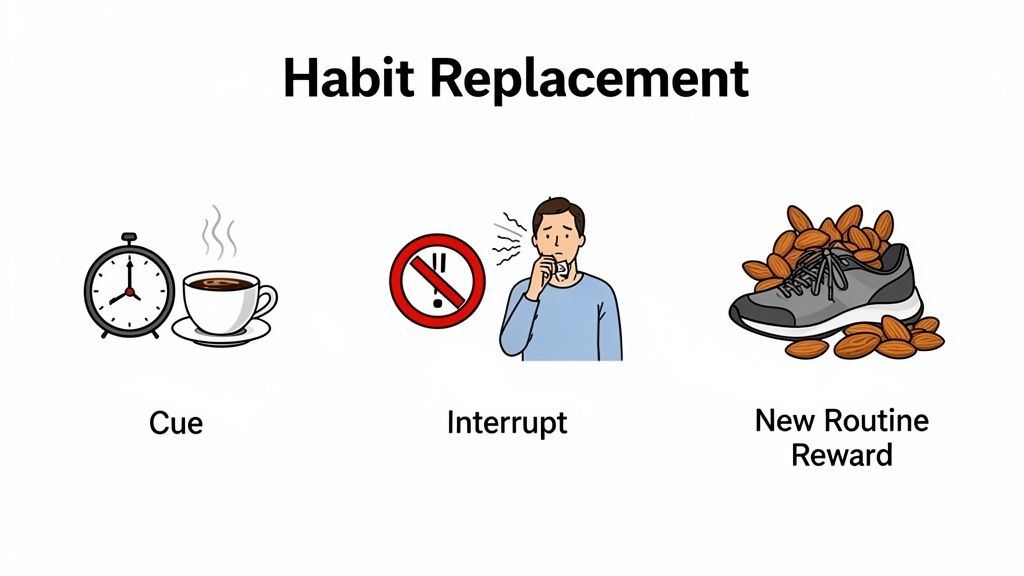
Knowing the science behind the habit loop is great, but putting it into practice is what really counts. This is where we get to roll up our sleeves and actively rewire those automatic sugar cravings. It’s a deliberate process, but it’s simpler than you might think. We're going to deconstruct the old habit and build a new, healthier one in its place.
First things first: you need to become a detective of your own behavior. For just a few days, really pay attention to when those sugar cravings hit. What’s going on right before you reach for something sweet? Are you bored, stressed, tired, or just wrapping up a meal? That trigger is your cue. Nailing it down is the most critical piece of the puzzle.
Once you know your cue, your next job is to interrupt the automatic routine that follows. The second you recognize that cue, you need to create a pause. This tiny moment of mindfulness is powerful—it snaps you out of the habit loop’s trance, turning an unconscious reaction into a conscious choice.
From Autopilot to Active Choice
Interrupting the routine doesn't need to be dramatic. It can be as simple as taking three deep breaths, walking into another room, or chugging a big glass of water. The whole point is to create just enough space to ask yourself one crucial question: "What do I really want right now?"
More often than not, the answer isn't actually sugar. You might really be craving:
- Energy to get through that 3 p.m. slump.
- Comfort after a tough meeting.
- Distraction from a boring task.
- Celebration for a small victory.
This brings us to the most important step: replacing the old routine. Your new behavior has to deliver a reward that satisfies the real need you just uncovered. If you need energy, a brisk five-minute walk will serve you far better than a candy bar. If you’re looking for comfort, a warm cup of herbal tea can work wonders.
The secret to lasting change isn't about deprivation. It's about finding a new, healthier behavior that provides a similar—or even better—reward than the old one did.
A Real-World Example in Action
Let’s say your trigger is the dreaded 3 p.m. work slump. Your automatic routine is to grab a cookie from the breakroom, and the reward is a quick sugar high and a break from your screen. Here’s how you could consciously build a new loop.
- Identify the Cue: The feeling of fatigue and distraction around 3 p.m.
- Interrupt the Routine: Instead of walking to the breakroom, stand up and stretch.
- Implement a New Routine: Walk over to the kitchen and grab a handful of almonds and a cold water.
- Acknowledge the New Reward: You get a steady, sustained energy boost from the protein and a real mental reset from the quick walk. It satisfies the original craving more effectively, without the crash.
It’s not just about in-the-moment choices, either. Setting yourself up for success ahead of time is huge. Learning how to meal prep for the week can make healthy options the easiest options. You can also explore different habit stacking examples to weave tiny, positive changes into your existing daily schedule.
This isn’t just theory; modern research backs it up. Studies show that simple binary tracking—like a daily yes/no check-in—can help people stick with new habits 27% longer in those crucial early stages.
This is exactly why tools that integrate these psychological principles can be so effective. Let’s look at how the features in the StopSugar app align with the science of habit change.
Applying Habit Psychology with StopSugar
| Psychological Principle | How It Works | StopSugar Feature |
|---|---|---|
| Habit Tracking & Reinforcement | Simple, daily tracking builds momentum and reinforces the new behavior, making you less likely to quit. | Daily Check-ins |
| Implementation Intentions | Pre-planning your response to a trigger ("If X happens, I will do Y") dramatically increases your chances of success. | Panic Button |
| Cue Interruption & Replacement | Having a go-to list of healthier alternatives ready before the craving strikes makes it easier to choose a new routine. | Sugar-Free Alternatives Library |
| Self-Awareness | Understanding the emotional triggers (cues) behind your cravings is the first step to changing your response. | Mood & Craving Logs |
Features like a "panic button" mimic powerful "implementation intentions," which have been shown to boost follow-through rates by up to 64%. By giving you an instant alternative when a craving hits, you're not left scrambling—you have a plan. The science is clear: building a supportive environment, even a digital one, makes a world of difference.
Common Questions About Changing Habits
Even when you know the psychology behind habits, actually changing something as deeply ingrained as eating sugar is going to come with questions and hurdles. That's just part of the process. Let's walk through some of the most common obstacles you'll likely face and how to handle them using what we've learned.
What if I Have a Slip-Up and Eat Sugar?
It's easy to see a slip-up as a total failure, but from a habit science perspective, it's just a piece of data. It is absolutely not a disaster. Research on long-term habit change shows that perfect consistency isn't what matters most. One mistake won't undo all the hard work you've put in.
The most critical thing is to get right back on track with your very next choice. Treat the slip-up as a learning moment. Ask yourself, what was the cue that triggered it? Were you stressed out, exhausted, or in a particular social setting? Pinpointing that trigger is your key to making a better plan for the next time it shows up.
Remember the golden rule of habit change: Never miss twice. A single slip-up is an outlier. A second one in a row starts to look like the beginning of a new, unwanted habit.
Jumping back in immediately reinforces your commitment and keeps that new neural pathway you're building nice and strong.
Will These Strategies Work for Very Strong Cravings?
Absolutely. These psychological strategies are effective precisely because they're designed for how your brain actually works. A really intense craving is just a sign that you have a powerful, well-established habit loop. Your brain knows there's a big reward waiting at the end, and it wants it.
Instead of trying to battle that craving with brute-force willpower (which is a fast track to exhaustion), the smarter move is to satisfy the underlying need with a new routine. Is the craving truly for sugar, or is your brain really after something else?
- Craving a quick energy boost? A brisk walk or a handful of almonds can do the trick.
- Craving comfort or calm? Try sipping a warm cup of herbal tea or doing five minutes of deep breathing exercises.
- Craving a distraction from boredom? Put on your favorite upbeat song or call a friend for a quick chat.
The goal here is to experiment. Try different replacement routines until you find something that delivers a similarly satisfying reward. Every time you successfully replace the sugar routine, you weaken that old connection and strengthen a new, healthier one.
How Do I Stay Motivated When Progress Feels Slow?
Let's be honest, motivation is fickle. It shows up one day and is gone the next. That's exactly why habits are so important—they're designed to run on autopilot, especially when you don't feel like sticking with it. When your motivation dips, your habit structure is there to catch you.
To stay in the game for the long haul, try shifting your focus away from the distant finish line and onto the process itself.
Celebrate the small wins. Seriously. Every daily check-in, every craving you ride out, and every healthy choice you make is a victory worth acknowledging. These little successes build momentum and reinforce your new identity as someone who isn't controlled by sugar. Tracking your progress—whether it's noticing you have more energy, clearer skin, or a better mood—creates a powerful feedback loop that generates its own motivation, showing you just how far you've already come.