10 Powerful Impulse Control Strategies to Crush Sugar Cravings
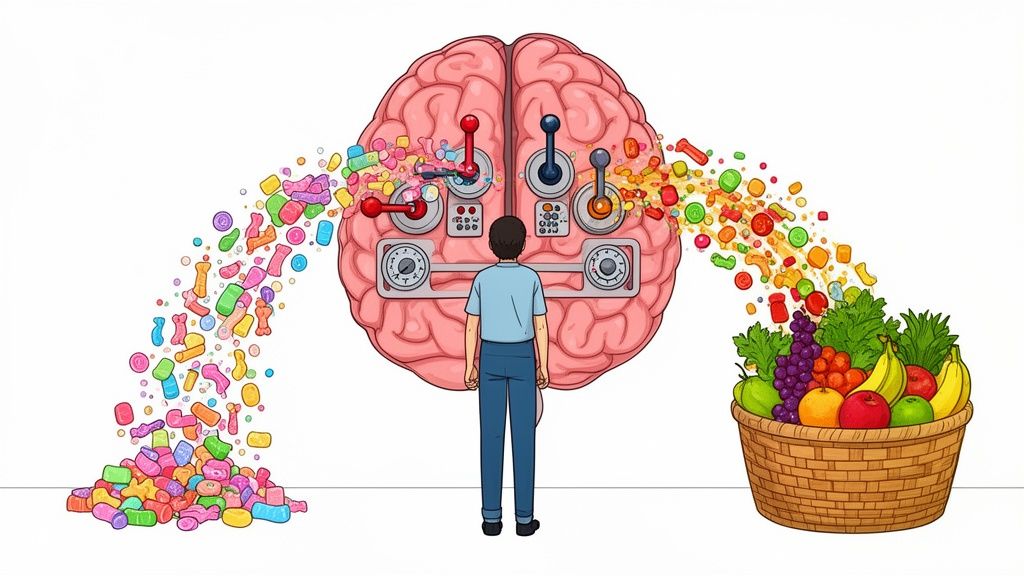
Feeling like you're in a constant battle with sugar? You're not alone. Many believe that overcoming intense sugar cravings is purely a matter of willpower, but the science tells a different story. Our brains are hardwired to seek out sugar, creating powerful biological impulses that can override even the strongest intentions. This isn't a personal failing or a lack of self-discipline; it's a deeply ingrained physiological response.
The key to winning this battle isn't gritting your teeth and hoping for the best. It's about using smarter, more effective impulse control strategies that work with your brain's wiring, not against it. Relying on sheer willpower is like trying to hold back a tidal wave with a bucket. Eventually, it will fail. A strategic approach, however, gives you the tools to redirect the wave before it crashes.
This article moves beyond generic advice and provides a toolkit of ten evidence-based techniques designed to give you back control. We will break down each strategy into simple, actionable steps that you can implement immediately. You’ll learn how to manage cravings in the moment, restructure your environment to minimize temptation, and build new habits that last.
For each method, we'll provide:
- Clear, step-by-step instructions.
- Real-world examples for different situations.
- Guidance on using features within the StopSugar app to support your efforts.
Get ready to leave the frustrating cycle of craving and guilt behind. It's time to build a sustainable, healthier relationship with food, one smart choice at a time.
1. The 10-Minute Delay Technique
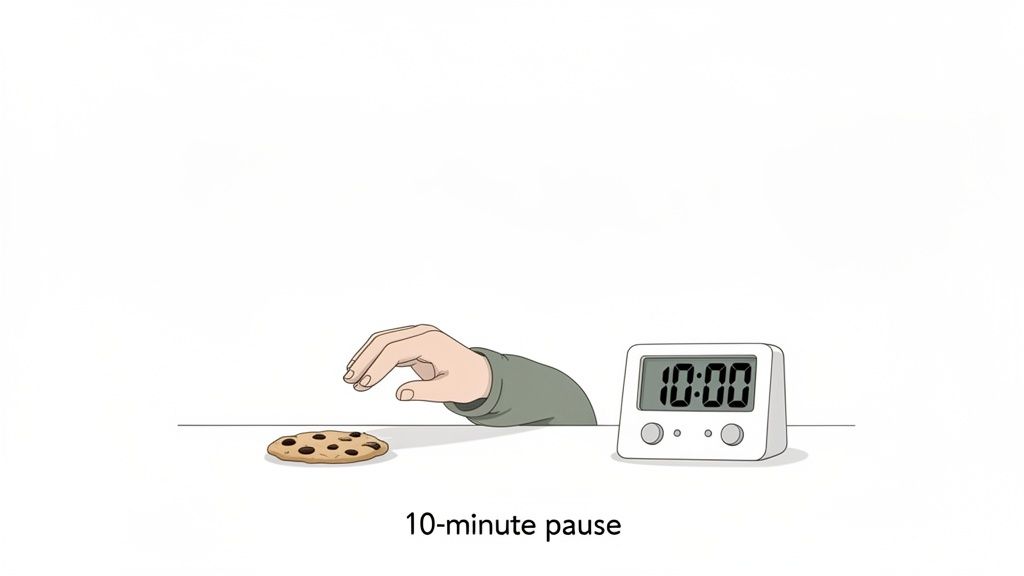
The 10-Minute Delay is one of the most effective and accessible impulse control strategies you can deploy. Popularized by Cognitive Behavioral Therapy (CBT) and addiction specialists, this technique involves a simple commitment: when a sugar craving strikes, you wait just 10 minutes before giving in. This short pause interrupts the automatic, impulsive reaction that often leads to unhealthy choices.
The science behind it is straightforward. Cravings are like waves; they build in intensity, peak, and then naturally recede. Research, including studies from Yale's The Craving Brain, shows this entire cycle often happens within 10-20 minutes. By delaying your response, you give your rational brain time to catch up with your emotional brain, allowing the initial overwhelming urge to weaken significantly.
How to Implement the 10-Minute Delay
Putting this strategy into practice is simple. The next time you feel an intense urge for a sugary snack, pause and tell yourself, "I can have it, but not for 10 minutes."
- Set a Timer: Immediately set a timer on your phone, watch, or use the StopSugar app’s Panic Button feature, which is designed specifically for this purpose.
- Change Your Environment: Get up and move. Walk to another room, step outside for fresh air, or do a few quick stretches. Changing your physical state can help reset your mental state.
- Engage in a Distraction: Drink a large glass of water, call a friend, or switch to a task that requires your focus. The goal is to redirect your attention away from the craving.
Real-World Example
Imagine you're at your desk around 3 PM, and the familiar afternoon slump hits. Your brain screams for the candy bar in the vending machine. Instead of immediately getting up, you activate the StopSugar Panic Button. For the next 10 minutes, you walk to the water cooler and chat with a colleague. By the time the timer goes off, the intense urge has faded, and you realize you were more tired than hungry. This simple pause helps you regain control.
2. Environmental Design (Choice Architecture)
Environmental Design, also known as Choice Architecture, is a powerful pre-commitment strategy that shapes your decisions by structuring your surroundings. Popularized by behavioral economists like Richard Thaler and authors like James Clear, this approach makes healthy choices the easiest and most obvious option. It operates on a simple principle: you are less likely to give in to a craving if the temptation isn't easily accessible.
This is one of the most effective impulse control strategies because it removes the need for willpower in the moment. Research shows that a significant portion of our daily decisions are habitual and influenced by our immediate environment. By curating your space to reduce sugar's visibility and convenience, you automate better choices and reduce decision fatigue.
How to Implement Environmental Design
Start by auditing your home, office, and even your car to identify "sugar traps." The goal is to make healthy options the path of least resistance.
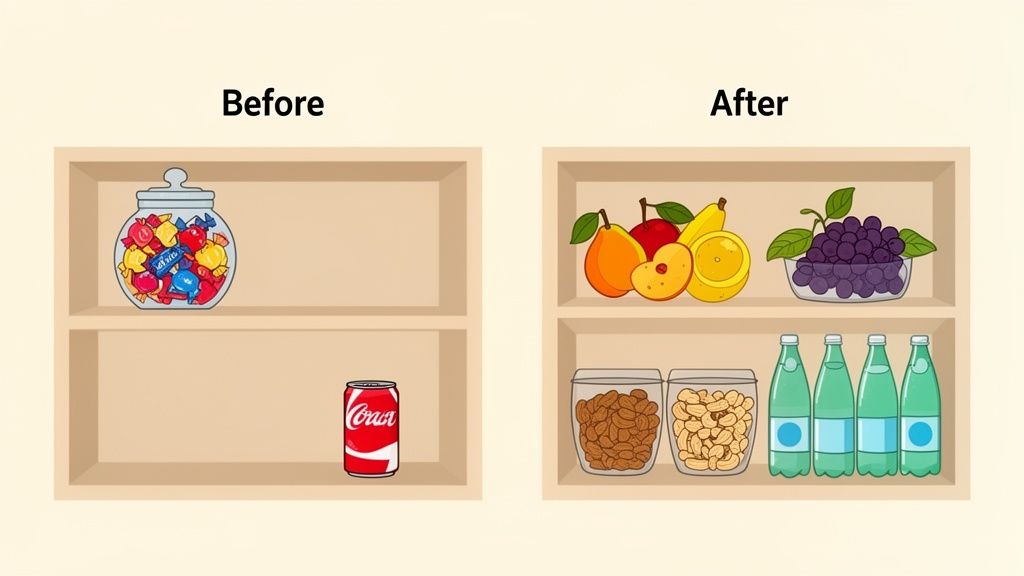
- Remove and Replace: Get rid of processed snacks, sugary drinks, and candy. Restock your pantry and fridge with appealing, healthy alternatives. Use the StopSugar app’s Alternatives feature to find delicious, low-sugar swaps.
- Increase Friction: If you must keep sugary items for others, make them difficult to access. Store them on a high shelf, in an opaque container, or in the back of the pantry.
- Make Healthy Visible: Place fruits in a bowl on the counter, keep chopped veggies and nuts at eye level in the fridge, and have a water bottle on your desk at all times.
Real-World Example
Imagine your office has a candy bowl on the reception desk that you pass every day. You decide to apply Environmental Design. You talk to your team and replace the candy with a bowl of mixed nuts, berries, and mandarin oranges. The temptation is now gone, replaced by a healthy choice. At home, you move sodas from the main fridge to a garage mini-fridge and stock the main fridge with sparkling water and fruit infusions. These small changes dramatically reduce your daily sugar intake without requiring constant self-control.
3. Mindfulness and Urge Surfing
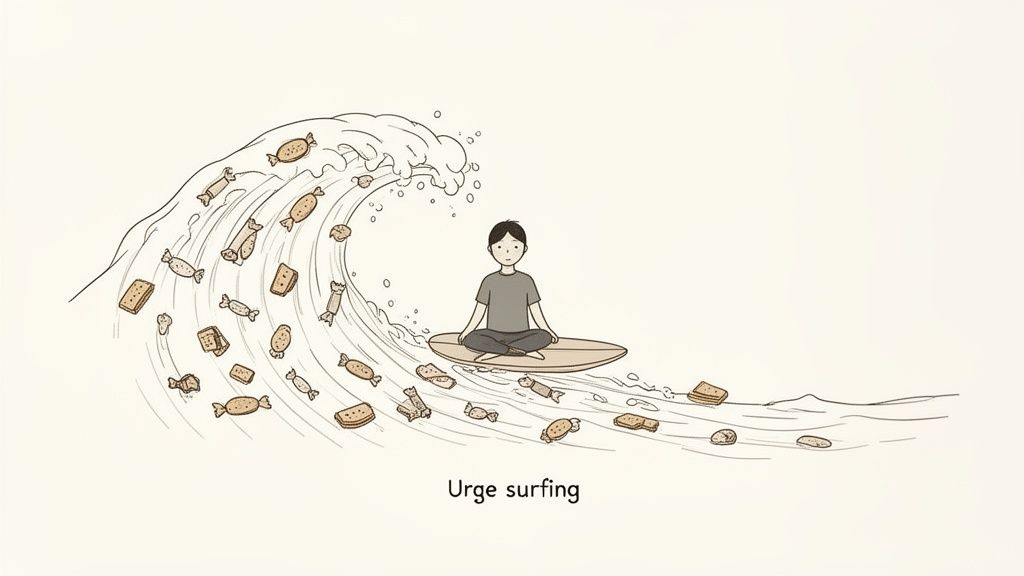
Mindfulness and Urge Surfing is one of the most powerful impulse control strategies for managing cravings. Pioneered by mindfulness leaders like Jon Kabat-Zinn and adapted for addiction by Dr. Judson Brewer, this technique teaches you to observe your sugar cravings without judgment. Instead of fighting the urge, you learn to "surf" it, treating it as a temporary wave of sensation that will naturally pass.
This approach is rooted in Mindfulness-Based Relapse Prevention (MBRP). The core idea is that by mindfully noticing the physical and mental sensations of a craving, you detach from the automatic impulse to act. You become an observer rather than a participant, which dramatically reduces the craving's power over you.
How to Implement Mindfulness and Urge Surfing
When a strong sugar craving arises, don't resist it. Instead, pause and mindfully acknowledge it.
- Observe Without Judgment: Close your eyes and notice where you feel the craving in your body. Is it a tightness in your stomach? A sensation in your mouth? Simply label the feelings: "This is a craving."
- Track the Sensation: Use the StopSugar app’s Daily Check-in to log the intensity of your craving on a 1-10 scale. Notice how it builds, peaks, and eventually subsides on its own.
- Focus on Your Breath: Gently guide your attention to your breathing. Inhale and exhale slowly, using your breath as an anchor while the wave of craving passes.
- Practice Proactively: Don't wait for a craving to practice. Start with short, guided meditations using apps like Calm or Headspace to build your mindfulness muscle. For more specific guidance, you can learn about mindful eating exercises to strengthen your awareness.
Real-World Example
You're in a high-stress meeting at work, and your mind immediately drifts to the donuts in the breakroom. Instead of fighting the thought, you take a moment to practice urge surfing. You close your eyes for a few seconds, take a deep breath, and mentally scan your body. You notice the urge as a knot in your chest and a dryness in your mouth. You observe it for a minute, and just like a wave, you feel it crest and then begin to fade, allowing you to refocus on the meeting without giving in.
4. Habit Stacking and Replacement
Habit Stacking and Replacement is one of the most powerful impulse control strategies for long-term change. Popularized by authors like James Clear and Charles Duhigg, this technique leverages the brain's existing neural pathways. Instead of fighting an old habit, you either link a new, desired behavior to an established one (stacking) or replace the negative routine with a positive one (replacement).
The science behind this is rooted in the "habit loop": a cue triggers a routine, which delivers a reward. By identifying the cue that triggers your sugar craving and the reward you seek, you can swap the sugary routine for a healthier one that provides a similar reward. This hijacks the loop, making the new habit feel less effortful and more automatic over time.
How to Implement Habit Stacking and Replacement
To put this into practice, you first need to deconstruct your sugar habit. The goal is to keep the cue and reward but change the routine in between.
- Identify Your Cue and Reward: What triggers your craving? Is it a time of day (the 3 PM slump), an emotion (stress), or a location (the kitchen)? What reward does sugar give you? Is it an energy boost, comfort, or a distraction?
- Choose a Replacement: Find a new routine that provides a similar reward. If you eat sugar for an energy boost, try a brisk walk or a high-protein snack. If it's for comfort, try a warm cup of herbal tea. Use StopSugar's Alternatives feature for evidence-based suggestions tailored to your specific craving.
- Stack It or Swap It: Stack a new habit onto an existing one, like "After I finish my lunch, I will immediately go for a 5-minute walk." Or, swap the routine directly: "When I feel stressed, instead of reaching for a cookie, I will open my journal."
Real-World Example
Imagine you have a deeply ingrained habit of eating a bowl of ice cream every night while watching TV (the cue). The reward is relaxation and comfort. To replace this, you keep the cue (watching TV) but swap the routine. Instead of ice cream, you prepare a cup of calming chamomile tea and a small bowl of berries. The reward is still comfort and a pleasant sensory experience, but you have successfully replaced the unhealthy habit with a better one. For a deeper dive, explore these habit stacking examples.
5. Implementation Intentions (If-Then Planning)
Implementation Intentions, often called If-Then Planning, is a powerful cognitive technique that essentially automates your response to temptations. Developed by psychologist Peter Gollwitzer, this strategy involves creating a specific, predetermined plan for high-risk situations. Instead of relying on willpower in the heat of the moment, you decide in advance how you will act, making the desired behavior automatic.
The science behind this method is compelling. It works by linking a situational cue (the "if") with a planned response (the "then"), which bypasses the slow, effortful decision-making part of your brain. Multiple meta-analyses have shown this to be one of the most effective impulse control strategies, with studies demonstrating adherence rates as high as 91%. You are effectively pre-loading a decision so your brain doesn't have to struggle when a craving strikes.
How to Implement If-Then Planning
To put this strategy into practice, you need to identify your personal triggers and create specific, actionable plans.
- Identify Your Triggers: Pinpoint your 3-5 highest-risk situations for sugar cravings. Is it stress after work? The 3 PM slump? Social events with dessert tables?
- Create Your Plans: For each trigger, create a clear "if-then" statement. For example, "If I feel stressed after work, then I will immediately change into my workout clothes and go for a 15-minute walk."
- Be Specific and Realistic: The "then" part of your plan must be concrete and easy to do. "Be healthier" is too vague. "Drink a large glass of sparkling water with lemon" is specific and actionable.
- Use the StopSugar App: Input your "if-then" plans directly into the StopSugar app. The app can send you reminders when your trigger times or situations are likely to occur, prompting your planned response.
Real-World Example
Imagine you're at a party and see a table full of desserts. This is one of your known triggers. Because you created an implementation intention beforehand, your brain automatically recalls the plan: "If I am at a social event with desserts, then I will get a sparkling water first and talk to a friend for five minutes." This pre-planned action gives you a buffer, interrupting the impulse to grab a brownie. By the time you've finished your water, the initial craving has often subsided, and you feel in control.
6. Social Accountability and Support Networks
Leveraging social commitment is a powerful impulse control strategy that shifts the burden from pure willpower to community-driven motivation. By sharing your goals with others, you create an external accountability system that makes you less likely to give in to impulsive cravings. This approach harnesses our natural desire for social connection and positive reinforcement to support personal change.
The effectiveness of this method is well-documented. Research highlighted by the American Society of Training and Development shows that making a public commitment to a specific goal can increase your chances of success by up to 65%. When you know others are aware of your journey, the stakes feel higher, and your commitment becomes more concrete. It moves your private struggle into a shared, supportive space.
How to Implement Social Accountability
Integrating social support into your sugar-reduction plan involves making your goals known and establishing a system for check-ins. It's about building a team to cheer you on.
- Find an Accountability Partner: Ask a friend, family member, or coworker with similar health goals to be your partner. Agree to check in with each other daily or weekly.
- Join a Community: Participate in online support groups like Reddit’s r/sugarfree or dedicated Facebook communities. Engaging with others on the same path normalizes the challenges and celebrates the wins.
- Make a Public Commitment: Announce your goal, such as a "30-Day Sugar-Free Challenge," on social media or within a group. This simple act of declaration strengthens your resolve.
- Use App-Based Communities: Join community challenges within the StopSugar app. Sharing your progress, milestones, and daily check-ins gamifies the experience and provides instant encouragement.
Real-World Example
Imagine you've decided to quit added sugar. You tell your best friend about your goal and ask them to be your accountability partner. You agree to send each other your StopSugar daily check-in screenshot every evening. One afternoon, you face a strong craving for a donut at the office. Knowing you have to report back to your friend later gives you the extra motivation to choose a healthier snack instead. This simple check-in system transforms a personal battle into a team effort.
7. Cognitive Reappraisal and Perspective Shifting
Cognitive Reappraisal is a powerful mental tool that changes how you think to change how you feel. Instead of just fighting a craving, this impulse control strategy involves actively reinterpreting its meaning. This technique, rooted in cognitive therapies developed by pioneers like Albert Ellis, shifts your brain’s response from the emotional, impulsive limbic system to the rational prefrontal cortex.
The science behind this is grounded in emotion regulation research. By consciously reframing a sugary temptation, you change its emotional power over you. For instance, you learn to see a donut not as a "reward" but as "a spike in blood sugar that will lead to an energy crash in an hour." This shift in perspective diminishes the craving’s appeal, making it easier to resist without relying solely on willpower.
How to Implement Cognitive Reappraisal
This strategy is about changing the story you tell yourself about sugar. When an urge arises, you consciously choose a new, more empowering perspective.
- Identify Your Rationalizations: Notice your go-to excuses for eating sugar, like "I deserve it" or "It's just one treat." Acknowledging these automatic thoughts is the first step.
- Create a Counter-Statement: Prepare a powerful reframe that connects to your core values. For example, change "I'm stressed and need cake" to "Cake is a temporary distraction; a walk will actually reduce my stress hormones."
- Be Specific and Visceral: Abstract reframes are weak. Make it concrete. Instead of "That soda is unhealthy," think, "That soda contains 10 teaspoons of pure sugar that will overload my system."
- Use the StopSugar App: Log the negative effects after you eat sugar in the Daily Check-in feature. This creates a data-driven feedback loop, reinforcing your reappraisals with your own experiences.
Real-World Example
You're at a birthday party, and someone offers you a large slice of cake. Your initial thought is, "It's a celebration, I should indulge!" Instead of automatically accepting, you pause and apply cognitive reappraisal. You reframe the thought: "This cake is engineered to be addictive and will make me feel sluggish tomorrow morning. I value feeling energetic and clear-headed more than a few moments of sweetness." A key to shifting perspective is actively identifying and learning how to challenge cognitive distortions. This reframes your relationship with your thoughts. You politely decline, feeling empowered by your choice rather than deprived.
8. Temptation Bundling and Reward Pairing
Temptation bundling is a powerful behavioral economics technique that links a behavior you want to do (like listening to a podcast) with a behavior you need to do (like avoiding sugar). Popularized by researcher Katherine Milkman, this method makes healthy choices more appealing by pairing them with an immediate reward, which is one of the most effective impulse control strategies for long-term consistency.
The science behind this is rooted in reward association. Your brain is wired to seek immediate gratification, which is why sugar is so tempting. By bundling a sugar-free alternative with something genuinely enjoyable, you create a new, positive feedback loop. This makes the healthy habit feel less like a sacrifice and more like a treat, leveraging your brain's reward system to work for you, not against you.
How to Implement Temptation Bundling
The key is to pair your desired healthy action with a genuinely compelling reward that you only get to enjoy when you perform that action.
- Identify Your "Wants": Make a list of things you truly enjoy, like listening to a specific podcast, watching an episode of a show, checking social media, or playing a quick mobile game.
- Pair with Your "Needs": Link one of your "wants" to a sugar-avoidance behavior. For example, "I can only listen to my favorite true-crime podcast while I'm on my afternoon walk instead of grabbing a candy bar."
- Be Strict with the Bundle: The reward must only be accessible when you perform the healthy habit. This exclusivity is what makes the strategy effective.
Real-World Example
Imagine you consistently crave a sweet coffee drink every morning. Instead of fighting the urge through willpower alone, you decide to use temptation bundling. You commit to making a sugar-free herbal tea or black coffee at home. While you drink it, you allow yourself 15 minutes to scroll through your favorite social media feed guilt-free. Soon, your brain starts associating the morning tea ritual not with deprivation, but with the pleasurable reward of checking in with friends, making the healthy choice feel effortless and enjoyable.
9. Pre-Commitment and Choice Restriction Devices
Pre-commitment is one of the most powerful impulse control strategies because it involves making decisions for your future self while you are still rational and in control. Inspired by the tale of Ulysses tying himself to the mast, this technique involves creating "choice restriction devices" that make it difficult or impossible to give in to a future craving. It's about designing your environment to enforce your best intentions.
The behavioral science behind this is compelling. Behavioral economists like Richard Thaler have shown that we often have two conflicting selves: a "planner" self who wants to be healthy and a "doer" self who succumbs to immediate temptation. Pre-commitment allows your planner self to set boundaries that your future doer self cannot easily break, effectively removing the need for willpower in the heat of the moment.
How to Implement Pre-Commitment
The key is to create a binding contract with yourself when your motivation is high, making it harder to back out later when a craving hits.
- Remove Temptation at the Source: The simplest pre-commitment is to not buy sugary snacks in the first place. If they aren't in your house, you can't eat them during a late-night craving.
- Create Financial Stakes: Use platforms like StickK or Beeminder to put money on the line. You commit to your goal, and if you fail to report your progress, you lose the money.
- Build Accountability: Tell a friend or partner about your commitment. For instance, you could give them your credit card on weekends with instructions not to let you buy processed foods.
- Use Technology: Use the StopSugar app's Daily Check-in as a form of pre-commitment. Making that public declaration in the morning reinforces your goal for the day.
Real-World Example
Imagine you've decided to complete a 30-day no-sugar challenge. To ensure you stick with it, you make a pre-commitment. You tell your family about your goal and make a household rule that no sugary desserts will be purchased for the month. You also use the StopSugar app to log your Daily Check-in each morning, solidifying your intent. When a coworker offers you a donut on day 15, the decision is already made. You've pre-committed to your goal, making it far easier to decline without an internal battle.
10. Stress Management and Emotional Regulation
Addressing the root cause of many sugar cravings is one of the most powerful impulse control strategies. This involves managing stress and regulating emotions, as research shows that up to 40% of non-hungry eating is emotionally driven. Instead of using sugar to cope with feelings like stress, anxiety, or boredom, this strategy focuses on developing healthier coping mechanisms.
The science behind this is rooted in our body's stress response. When we're stressed, our bodies release cortisol, a hormone that increases appetite and motivation to eat, particularly for high-fat, sugary foods. By learning to manage the underlying emotion, you short-circuit this physiological trigger. For a deeper dive into controlling your emotional responses, you might find it beneficial to learn more about understanding and mastering emotional regulation.
How to Implement Stress Management and Emotional Regulation
Developing emotional awareness is the first step toward breaking the cycle of emotional eating. Instead of reacting with food, you learn to respond with intention.
- Identify Your Triggers: Use the StopSugar app’s mood tracker to log how you feel before a craving hits. This helps you identify patterns, such as reaching for sugar when you're feeling anxious or overwhelmed.
- Create a Coping Menu: Brainstorm a list of non-food activities that help you manage specific emotions. For stress, this might be a short walk or deep breathing exercises. For boredom, it could be calling a friend or starting a creative project.
- Practice Proactive Self-Care: Don't wait for a crisis. Integrate stress-reducing activities like meditation, exercise, or journaling into your daily routine to build emotional resilience. You can learn more about stopping emotional eating and find sustainable alternatives.
Real-World Example
Imagine you've just had a stressful meeting at work. Your immediate impulse is to grab a donut from the breakroom to "reward" yourself for getting through it. Instead, you check your pre-made coping menu. You see "5-minute box breathing for anxiety." You step outside, practice the breathing technique, and feel the tension release. The intense craving for the donut subsides, replaced by a sense of calm and control.
10-Strategy Impulse Control Comparison
| Technique | 🔄 Implementation Complexity | ⚡ Resource Requirements | 📊 Expected Outcomes | 💡 Ideal Use Cases | ⭐ Key Advantages |
|---|---|---|---|---|---|
| The 10-Minute Delay Technique | Low — quick to apply | Minimal — timer or app | Short-term craving reduction; builds awareness | Acute impulses, on-the-go situations | Simple, immediate relief; scalable ⭐⭐⭐ |
| Environmental Design (Choice Architecture) | Medium — initial setup/planning | Moderate — time, re-stocking alternatives | Sustained reduction in exposure and temptations | Home/workplace redesign; family-wide change | Removes daily decision burden; high long-term impact ⭐⭐⭐⭐ |
| Mindfulness and Urge Surfing | Medium–High — learning curve | Moderate — daily practice, guided apps | Long-term resilience; reduced emotional reactivity | Emotional eating, stress-triggered cravings | Addresses root causes; strong clinical support ⭐⭐⭐⭐ |
| Habit Stacking and Replacement | Medium — requires mapping cues/rewards | Moderate — preparation, consistent practice | Automatic healthier routines after weeks | Contextual habits (e.g., afternoon snacks) | Sustainable; leverages existing routines ⭐⭐⭐⭐ |
| Implementation Intentions (If–Then Planning) | Low–Medium — upfront planning required | Minimal — write plans and reminders | High immediate adherence; automates responses | Predictable triggers and recurring situations | Research-backed high effectiveness when specific ⭐⭐⭐⭐ |
| Social Accountability & Support Networks | Low–Medium — join/create groups | Moderate — time, social engagement | Improved follow-through and motivation long-term | Those comfortable sharing goals; team challenges | Increases motivation, reduces isolation ⭐⭐⭐ |
| Cognitive Reappraisal & Perspective Shifting | Medium — cognitive practice needed | Low–Moderate — reflection, journaling | Gradual change in craving appeal and decisions | Values-driven motivation; self-guided change | Reframes temptations; builds lasting motivation ⭐⭐⭐ |
| Temptation Bundling & Reward Pairing | Low — identify and pair rewards | Moderate — rewarding activities or items | Higher adherence by making healthy choices pleasurable | Pairing non-food rewards with replacements | Makes healthy choices feel indulgent; easy to adjust ⭐⭐⭐ |
| Pre-Commitment & Choice Restriction Devices | Medium — set up constraints/contracts | Low–Moderate — tools, possible financial stakes | Very high compliance when enforced | Severe impulse control, predictable weak moments | Powerful external enforcement; "set-and-forget" results ⭐⭐⭐⭐ |
| Stress Management & Emotional Regulation | High — ongoing skill development | High — time, possible therapy/support | Reduces emotional eating; broad mental-health gains | Chronic stress or emotion-driven eating | Targets root emotional drivers; durable benefits ⭐⭐⭐⭐ |
Your Roadmap to Mastering Sugar Impulses
You’ve just explored a comprehensive toolkit of ten powerful, evidence-based impulse control strategies designed to help you reclaim your power over sugar cravings. From the immediate, in-the-moment tactic of the 10-Minute Delay to the long-term, life-shaping power of Environmental Design and Stress Management, you now have a diverse set of tools at your disposal. This isn't about finding one perfect solution; it's about building a personalized system that works for your unique lifestyle, triggers, and goals.
The journey to mastering your impulses is not a sprint, it’s a marathon built on small, consistent victories. The true power lies not in reading about these techniques but in applying them. Each time you pause, reframe a thought, or choose a healthier alternative, you are actively rewiring your brain. You are weakening the old, automatic neural pathways that lead to a sugar binge and strengthening new ones that lead to conscious, empowered choices.
Turning Knowledge into Actionable Steps
Information alone doesn't create change. The next step is to transform these concepts into tangible actions. Here’s a simple, effective way to begin your journey today:
- Select Your Starting Strategy: Don't try to implement all ten strategies at once. That's a recipe for overwhelm. Instead, review the list and pick just one or two that feel the most achievable and relevant to your biggest challenges right now. Is your 3 PM slump the problem? Maybe Temptation Bundling is your best starting point. Do you mindlessly snack while watching TV? Environmental Design could be a game-changer.
- Define Your "If-Then" Plan: For the strategy you've chosen, create a specific Implementation Intention. For example, if you chose the 10-Minute Delay, your plan could be: "If I feel a strong craving for a cookie after dinner, then I will immediately start a 10-minute timer on my phone and drink a full glass of water."
- Leverage Your Digital Toolkit: This is where a tool like the StopSugar app becomes your implementation partner.
- Daily Check-ins: Use the check-in feature to log whether you successfully used your chosen strategy. This simple act of tracking builds accountability and momentum.
- Panic Button: When a craving feels overwhelming, use the Panic Button to get an immediate, guided intervention that walks you through a technique like Urge Surfing or Cognitive Reappraisal.
- Alternatives: If you successfully delay or manage a craving, browse the alternatives section for a rewarding, non-sugar activity or snack to celebrate your win.
The Long-Term Vision: A Life of Freedom and Vitality
Mastering these impulse control strategies offers benefits that extend far beyond simply eating less sugar. This is about building the fundamental skill of self-regulation, which impacts every area of your life. When you can consciously manage your impulses, you gain:
- Stable Energy and Mood: Say goodbye to the dramatic highs and crushing lows of the sugar roller coaster.
- Improved Health and Well-being: You reduce your risk for chronic diseases and support your body’s natural vitality.
- Increased Self-Trust and Confidence: Every successful choice reinforces the belief that you are in control of your actions and capable of achieving your goals.
Think of this article as your map. You now know the terrain, you’ve seen the different paths, and you have a compass in the form of practical tools and techniques. The destination is a life where you, not your cravings, are in the driver's seat. The path forward is built one conscious choice at a time. Pick your first step, commit to it, and begin building a future free from the grip of sugar. You have the knowledge, you have the strategies, and you absolutely have the capacity to succeed.