Intuitive Eating for Weight Loss A New Approach
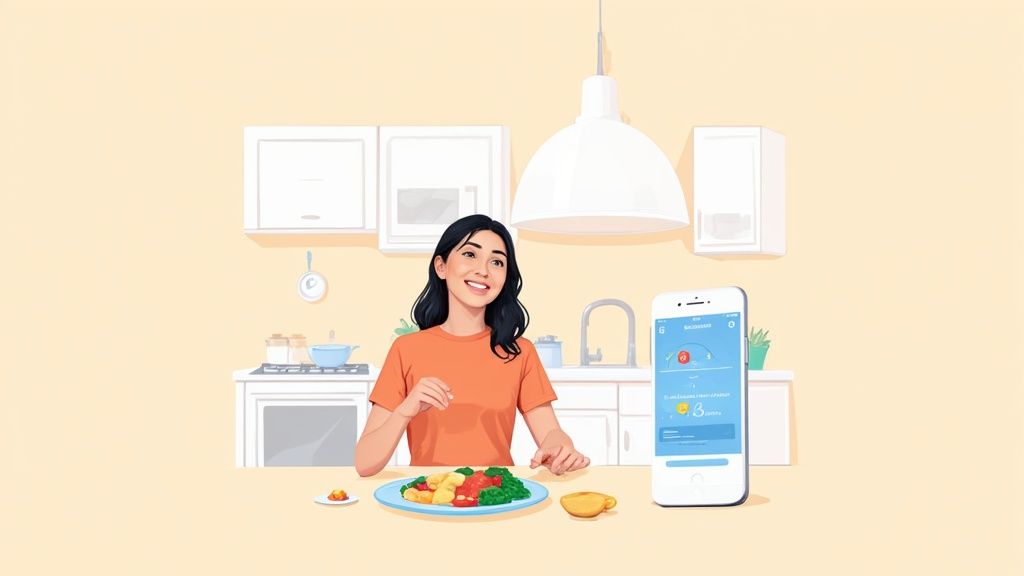
Intuitive eating and weight loss can absolutely go hand in hand. The real magic happens when you stop fighting your body with restrictive diets and start working with it. By learning to tune into your natural hunger and fullness cues, you begin to break the exhausting diet-binge cycle, and many people find their weight naturally settles into a healthy place.
It’s all about creating a sustainable, long-term approach to your health.
A New Perspective on Weight and Wellbeing
Let's get one thing straight from the start: intuitive eating is not a diet. In fact, it's the complete opposite—a way to unlearn all the toxic rules diet culture has taught us and get back in touch with our own bodies. While weight loss isn't the main goal, it often becomes a welcome side effect of healing your relationship with food.
Think about it. Traditional diets are all about external rules—counting every calorie, cutting out entire food groups, and sticking to rigid meal plans. This approach usually backfires, leading to deprivation, overwhelming cravings, and a whole lot of guilt. Intuitive eating throws that old rulebook out the window and teaches you to listen to your internal signals instead.
Ditching the Diet Mentality for Good
The very first step is to let go of the idea that another diet holds the key to your happiness. For years, we've been conditioned to believe that managing our weight requires strict, rigid control. Intuitive eating offers a much kinder, more effective path.
When you learn to trust your body, you can finally step off the frustrating treadmill of weight cycling—that endless pattern of losing and regaining weight. Instead, you start working toward finding the healthy weight range your body is naturally meant to be at.
And there's solid evidence to back this up. A major review of 26 different studies found a clear connection between intuitive eating and a lower body mass index (BMI). On average, people who practiced intuitive eating had a BMI that was 1.5 to 2.5 points lower than those who didn't. It just goes to show that tuning into your body's needs is far more effective than constantly fighting against them. Discover more insights from the BMI study.
The Core Idea Unpacked
So, how does this actually work day-to-day? It's about building a new set of skills and awareness in a few key areas:
- Honoring Physical Hunger: You learn to spot the first subtle signs of hunger and eat before you get to that "I'm so hungry I could eat anything" point.
- Respecting Fullness: This means paying attention while you eat, noticing when you feel comfortably satisfied, and giving yourself permission to stop—even if there's still food on your plate.
- Making Peace with Food: You give yourself unconditional permission to eat whatever you want. This might sound scary, but it’s what finally takes the power away from "forbidden" foods and stops those out-of-control cravings.
- Coping with Emotions: We all eat for emotional reasons sometimes. The key is to find other ways to deal with stress, boredom, or sadness so that food isn't your only go-to coping tool.
To help visualize this shift, let's break down the key differences between the old way of thinking and this new, more intuitive approach.
Dieting Mentality vs Intuitive Eating Mindset
| Aspect | Dieting Mentality | Intuitive Eating Mindset |
|---|---|---|
| Food Rules | External: "I can't eat carbs after 6 PM." | Internal: "Am I hungry? What does my body feel like eating?" |
| Success Metric | The number on the scale. | Feeling energized, satisfied, and at peace with food. |
| "Forbidden" Foods | Creates intense cravings and a sense of failure. | No foods are off-limits, which reduces their appeal. |
| Emotional Eating | A sign of weakness or a "cheat." | An opportunity to ask, "What do I really need right now?" |
| Body Trust | Body is seen as something to control and fight. | Body is seen as a wise partner to listen to and trust. |
Seeing it laid out like this really highlights how different the two mindsets are. One is built on restriction and distrust, while the other is rooted in self-care and respect.
Ultimately, choosing intuitive eating is about playing the long game. It’s a journey of unlearning old habits, practicing self-compassion, and finally finding a peaceful way to nourish yourself that supports both your mind and body.
How to Hear What Your Body Is Telling You
The first real step toward intuitive eating is simply learning to listen. After years of diets teaching us to ignore our body’s cues, it's time to tune back in. This all starts with understanding the crucial difference between physical hunger—your body’s genuine need for fuel—and emotional hunger, which is often just a call for comfort, not calories.
Physical hunger doesn't usually hit you like a ton of bricks. It builds gradually. You might notice a gentle rumbling in your stomach, feel your energy dip a bit, or find it harder to concentrate. Emotional hunger, on the other hand, often feels sudden and urgent, and it usually craves something specific, like ice cream or chips.
The Hunger and Fullness Scale
One of the best tools I've found for this is the hunger and fullness scale. It’s a simple way to rate your body's signals on a scale from 1 to 10.
- 1: You’re absolutely ravenous, maybe even feeling weak or irritable.
- 5: You’re neutral—not hungry, not full. Just content.
- 10: You’re uncomfortably stuffed, to the point of feeling sick.
The sweet spot? Aim to start eating when you’re at a 3 or 4 (pleasantly hungry) and stop when you hit a 6 or 7 (comfortably full and satisfied). This simple practice helps you avoid getting so hungry that you overeat later, and it teaches you to recognize that pleasant point of satisfaction before you feel bloated.
A Practical Mid-Meal Pause
Here’s another incredibly simple but effective technique: the mid-meal pause. When you’re about halfway through your meal, just put your fork down for a minute. Take a deep breath and ask yourself, "How does this food taste? Am I actually still enjoying it? Where am I on that hunger scale right now?"
This tiny break is powerful. It snaps you out of mindless eating and gives your brain a moment to catch up with your stomach. You might be surprised to realize you’re already feeling full and can save the rest for later. If you’re still hungry, great! You can keep eating, but now you’re doing it with purpose and enjoyment. If you want to explore this more, these simple mindful eating exercises are a great place to start.
This simple decision tree below really gets to the heart of what intuitive eating is all about: responding to real hunger versus emotional triggers.
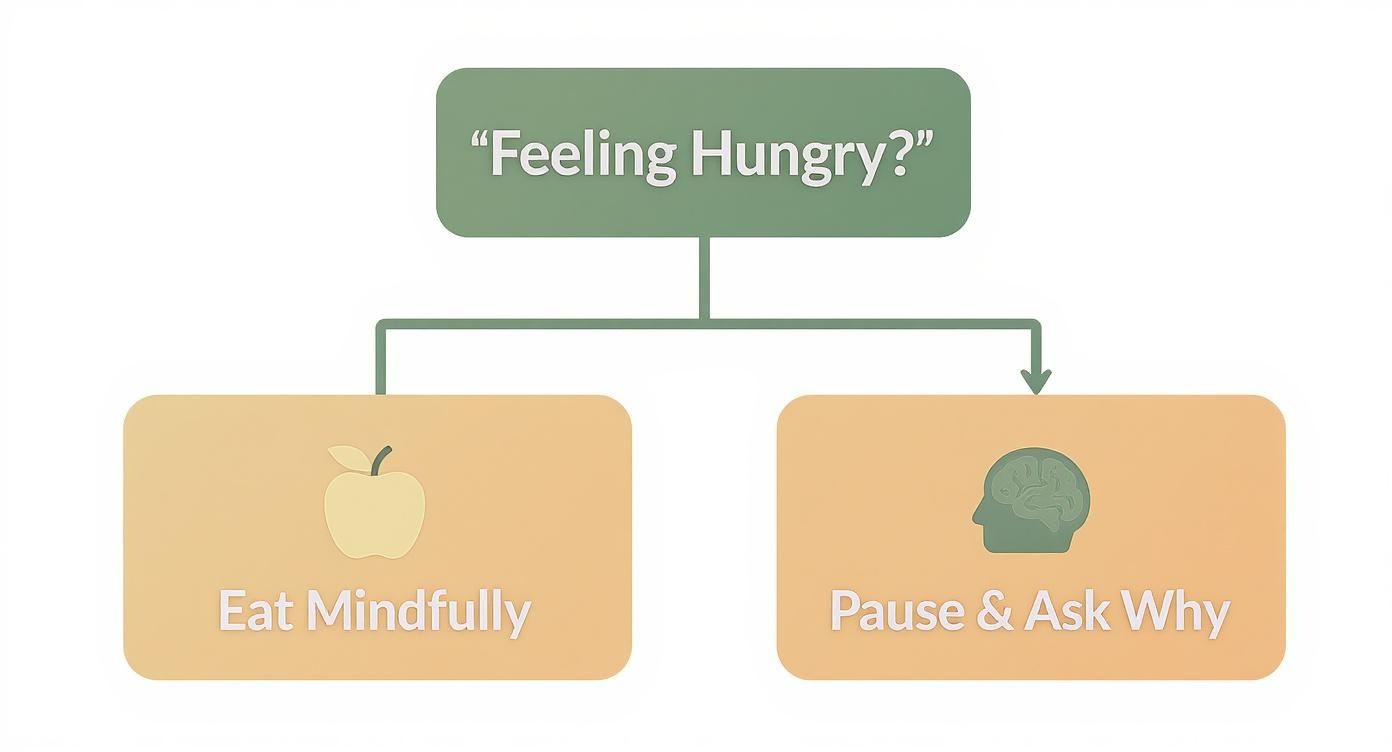
The big takeaway here is that not every urge to eat is about physical need. That small pause gives you the power to choose a response that truly nourishes you.
What to Do When Boredom Strikes
Let’s walk through a common scenario. It’s 3 PM, you’ve wrapped up a big task, and you find yourself wandering toward the kitchen. Before you grab something, stop. Ask yourself: "Am I physically hungry, or am I just bored?"
If it's genuine hunger, have a satisfying snack! But if you realize it’s boredom talking, you can find a solution that doesn't involve food. Maybe you can stretch, walk around the block, or call a friend.
This skill of tuning in has a name: interoceptive awareness. It’s your ability to feel and interpret what’s going on inside your body. The stronger it gets, the easier it is to trust yourself and make choices that support your well-being.
By practicing these little check-ins throughout your day, you’ll start to rebuild that vital connection with your body. It won't be long before you can easily tell what it truly needs.
Making Peace with Your Forbidden Foods
Let’s be honest: giving yourself unconditional permission to eat can be the scariest part of this whole journey. It’s a thought that trips up almost everyone. "If I let myself have donuts, won't I just eat them all day, every day?" It’s a completely valid fear, especially after years of hearing that some foods are just plain "bad."
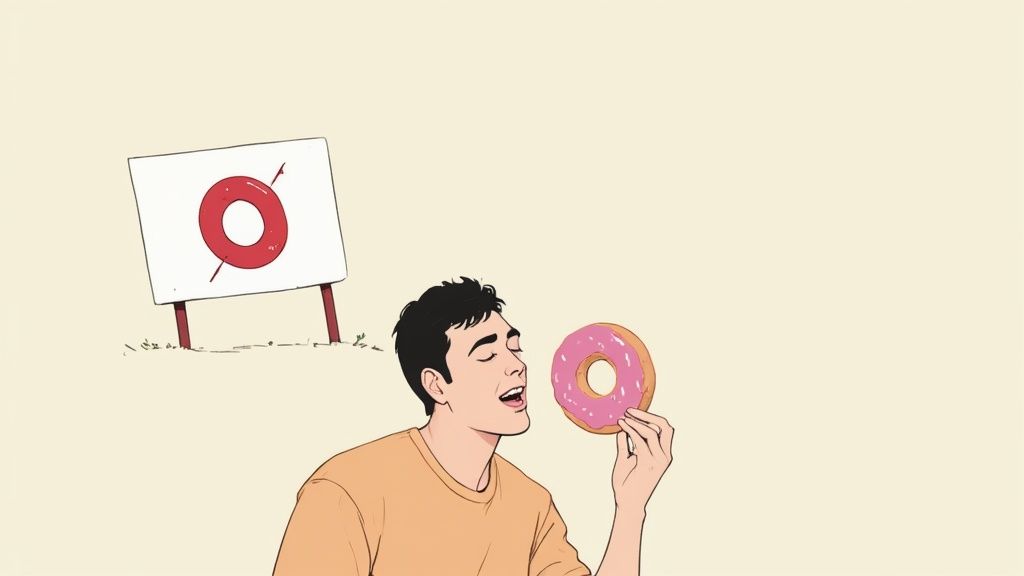
But here's what's really going on. The moment you label something as forbidden, you put it on a pedestal. That restriction is the very thing that fuels intense cravings and a powerful feeling of being deprived. Breaking that cycle is the key to finding a real, sustainable balance.
This isn't about suddenly deciding to live on processed foods. It’s about taking away their power over you. When no food is truly off-limits, the obsessive thoughts and overwhelming urges start to quiet down. Slowly but surely, you start building a relationship with food based on trust, not fear.
The Psychology of Cravings
Ever heard of "last supper" eating? It’s that blowout meal people have right before starting a new diet, where they cram in all the foods they won't be "allowed" to eat anymore. This creates a scarcity mindset. Your brain becomes obsessed with what it can't have, which ironically makes you crave it even more.
Making peace with these foods flips that script. You’re teaching your brain that these things are always available. That simple shift calms the primal urge to binge on them whenever you get the chance. It's a fundamental step toward a healthier relationship with food and, for many, sustainable weight management.
And the research backs this up. One major longitudinal study followed over 2,000 young adults for eight years. It found that intuitive eaters had 30-40% lower odds of chronic dieting and 25% lower odds of binge eating. Their weight also remained much more stable over time. You can read the full research about these findings to see the data for yourself.
A Practical Guide to Reintroducing Feared Foods
Ready to take the first step? This is a deliberate, mindful process—not a free-for-all. The goal is to bring these foods back into your life slowly and with total intention.
Here’s a simple way to get started:
- Pick one food. Just one. Let's say it's chocolate chip cookies.
- Start small. Don't buy a whole package. Go to a nice bakery and buy just one or two really good ones. Quality over quantity.
- Set the scene. Sit down at a table without distractions. No TV, no phone, no laptop. Just you and the cookie.
- Savor every single bite. Pay attention to the whole experience. What does it smell like? What’s the texture? Chew slowly and really notice the flavor.
- Check in with yourself. Halfway through, just pause. Ask yourself, "Am I still enjoying this? How does my body feel?" This isn't about guilt; it's about curiosity and gathering information.
- Note your satisfaction. When you’re finished, notice how you feel. Are you satisfied? Do you feel physically good?
The point of this exercise is to prove to yourself that you can eat a "forbidden" food and the world won't end. You're in control. The food doesn't have power over you; you have power over the food.
By repeating this process with different foods, you gradually dismantle the fear and guilt you've built up around them. You might be surprised to find that once the novelty wears off, you don’t even want those foods as often as you thought. This is how you make peace with food, one mindful bite at a time.
Finding Better Ways to Cope with Emotions
Let's be real—we all eat for reasons that have nothing to do with a rumbling stomach. A brutal day at work, a boring afternoon, or a sudden wave of sadness can send us straight to the pantry for a little comfort. That's a totally normal human thing to do.
But it becomes a problem when food is our only tool for coping. When that happens, it can really get in the way of our health and weight loss goals.
The whole point of intuitive eating is to recognize those emotional triggers and build a bigger, better toolkit for dealing with them. It’s about being kinder to yourself and finding strategies that actually solve the root problem, instead of just slapping a food-shaped band-aid on it. This shift is what truly builds emotional resilience.
Identifying Your Emotional Triggers
The first step is to become a detective of your own habits. When you find yourself reaching for a snack, just take a breath and ask, "What am I really feeling right now?" Is it stress? Loneliness? Anxiety? Maybe just pure, unadulterated boredom?
A lot of people find it eye-opening to keep a simple log for a week or so. You don’t need a fancy app; a small notebook and a pen work perfectly. Just jot down when you eat, what you eat, and—this is the important part—the emotion you were feeling right before.
You’ll probably start to see patterns you never noticed before. Maybe you crave something sweet every time you feel overwhelmed by your to-do list, or you head for salty snacks when you're feeling lonely at night.
Once you can put a name to the emotion, you can start finding a more direct way to soothe it. Learning how to stop emotional eating isn’t about restricting yourself; it’s about giving yourself more self-care options.
Building Your Personalized Coping Toolkit
The goal here isn't to ban comfort eating forever. It’s about having other appealing choices on deck so that food isn’t your only go-to. Your toolkit should be completely personal, filled with things you actually enjoy and find relaxing.
Remember, the key is to match the solution to the feeling. If you're feeling lonely, calling a friend will do a lot more for you than a bag of chips. If you're stressed, a quick walk around the block is probably going to lower your cortisol levels more effectively than a pint of ice cream.
Here are a few ideas to get you started. Think about having options that fit different moods, situations, and time limits.
- When you're stressed or anxious: A 5-minute guided meditation can work wonders. Or maybe just some deep breathing exercises or putting on a calming playlist.
- When you're bored: Step outside for some fresh air. Tackle that one tiny organizing project you've been putting off. Listen to an interesting podcast.
- When you're sad or lonely: Write down what you're feeling in a journal. Look through some old photos that make you smile. Shoot a text to a friend who always gets you.
- When you're procrastinating: Set a timer for just 10 minutes and dive into the task you're avoiding. Just starting is often the hardest part!
This isn't about having more willpower. It’s about having more self-awareness and being kind to yourself. By giving yourself more ways to cope, you're empowered to make choices that support both your emotional and physical health, which is the secret to making lasting changes.
Using Gentle Nutrition to Feel Your Best
After you’ve spent some time healing your relationship with food, the next natural step is to explore what "gentle nutrition" means for you. Let's be clear: this isn't dieting in disguise. We’re not bringing back strict rules or forbidden food lists. It's about making food choices that respect your health and your taste buds, creating an approach that feels flexible, compassionate, and genuinely good.
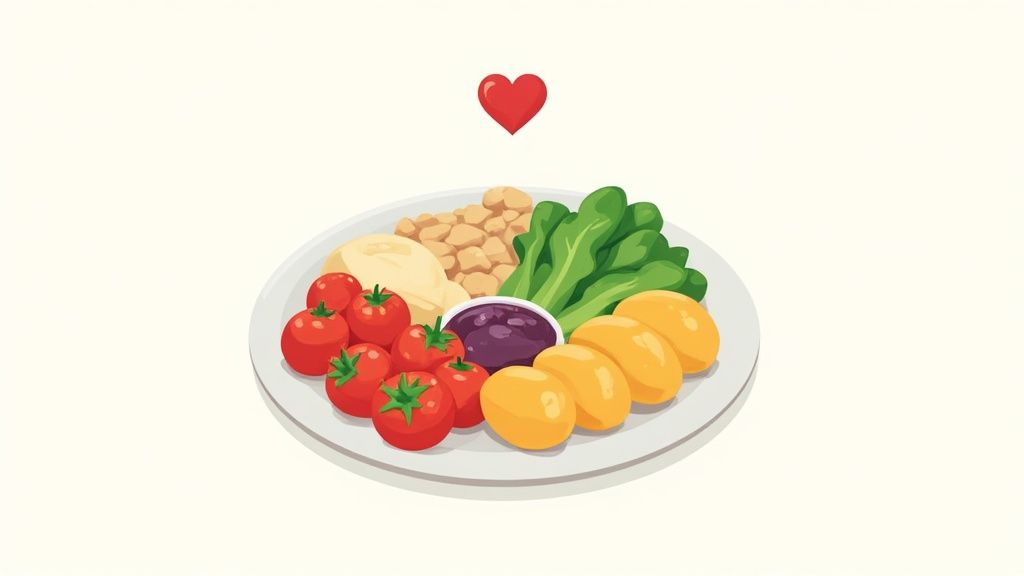
The entire mindset shifts from taking things out to adding nutrients in. This is a small change in thinking with a massive impact. It allows you to give your body what it needs without ever feeling like you're missing out. Remember, it's about progress, not perfection. What you eat over the long haul matters infinitely more than any single meal.
Adding In, Not Taking Away
A really practical way to start is to ask yourself one simple question: "What can I add to this meal to make it more satisfying and energizing?" This one question can completely change how you approach your plate.
Let's say your go-to afternoon snack is a handful of pretzels. They’re great, but maybe you’ve noticed you’re hungry again an hour later. Instead of forcing yourself to give them up, just think about what you could add to the mix.
- Boost the Protein: How about a slice of turkey or a small handful of almonds on the side? That protein will help you stay full much longer.
- Bring in Some Fiber: Pairing the pretzels with an apple, or some hummus and carrot sticks, adds valuable nutrients that increase that feeling of satisfaction.
- Include Healthy Fat: A small piece of cheese or a spoonful of guacamole can provide more sustained energy and make the whole snack feel more complete.
This "addition" strategy is the heart of gentle nutrition. You’re not villainizing any foods. You're just building a toolkit of nourishing options that help your favorite meals and snacks work better for your body.
What Balanced Meals Actually Feel Like
As you practice this, you’ll start building more balanced meals without really trying. It just becomes second nature. You'll start to learn firsthand how different combinations of macronutrients—that's your protein, fat, and carbohydrates—personally affect your energy levels and how full you feel. A little background on what macronutrients and micronutrients are can be helpful here, but it’s a guide, not a rulebook.
You might discover that a protein-rich breakfast helps you stay sharp all morning, or that adding a source of healthy fat to your lunch completely wipes out that 3 p.m. energy crash. This is your body giving you direct feedback. Gentle nutrition is simply the art of learning to listen to it.
Gentle nutrition is the final, beautiful piece of the intuitive eating puzzle. It’s where you combine your newfound body wisdom with nutritional knowledge to make choices that make you feel fantastic, both physically and mentally.
And this approach isn't just about feeling good—it works. Research has shown that intuitive eating can be a protective factor against being overweight. One study across multiple countries found that university students who scored high on intuitive eating were 40% less likely to be overweight or obese. They were also more likely to eat more fruits and vegetables. It's powerful proof that trusting your body and nourishing it with intention leads to a healthier, more sustainable way of life.
Got Questions About Intuitive Eating? Let's Talk.
Starting with intuitive eating often brings up a ton of questions and, let's be honest, a little bit of doubt. It's a huge departure from the diet world we've all lived in, so feeling uncertain is totally normal. Let's dig into some of the big questions I hear all the time to help you feel more confident as you begin.
Remember, this whole thing is about unlearning a lifetime of food rules. The most important tool you have is patience with yourself. There's no "right" way or perfect timeline—just your own journey.
Can You Actually Lose Weight This Way?
Okay, let's get right to it. While weight loss isn't the main goal, many people do find that their weight settles into a healthier, more natural place. The real win here is healing your relationship with food and breaking free from that exhausting cycle of restricting and then binging.
When you do that, your body finally gets a chance to find its natural set point weight. Think of any weight loss as a happy side effect of building better habits, not the end-all-be-all. That mental shift is exactly what makes this approach stick for the long haul.
But What if I Only Crave Junk Food?
This is the number one fear I hear, and I completely get it. When you finally give yourself total permission to eat whatever you want, it's very likely you'll make a beeline for all the foods that were once off-limits. This is not just normal; it's an expected—and necessary—part of the process.
This is often called the "honeymoon period," and I promise, it doesn't last. Once your mind and body truly start to believe that cookies or chips are always an option, the intense, urgent "I-need-it-now" cravings begin to fade. You'll also start paying more attention to how different foods actually make you feel, which naturally nudges you toward choices that give you energy and make your body feel good.
A sense of balance will eventually show up, all without you having to force it.
How Long Does This Actually Take?
There's no set timeline or finish line here. This is a deeply personal journey, all about rebuilding the trust between you and your body. For some people, the main ideas click in just a few months. For others who have been on the diet rollercoaster for 20 or 30 years, it might take a year or more to truly feel at peace.
Keep these things in your back pocket:
- Progress is messy. Some days will feel like a breakthrough, and others will feel like a step back. That’s okay.
- Be kind to yourself. You wouldn't criticize a friend for learning something new, so don't do it to yourself.
- Every meal is a chance to practice. Each time you sit down to eat, it's a fresh opportunity to check in and listen to what your body is telling you.