A Realistic Guide on How to Stop Binge Eating for Good
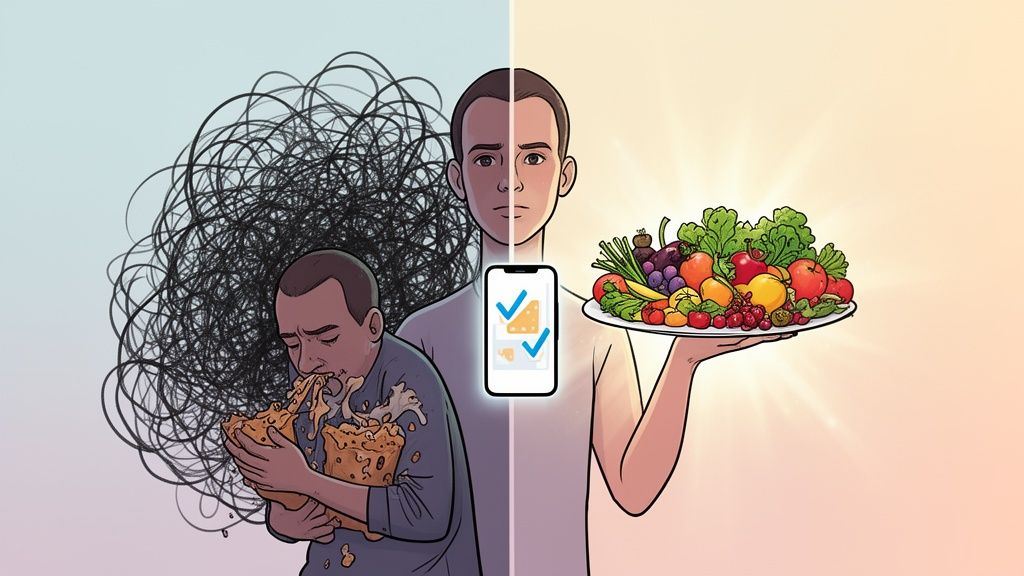
If you're trying to break the binge eating cycle, it's not about finding more willpower. It's about a smarter, more compassionate approach. The path forward really boils down to three key things: understanding your personal triggers, having in-the-moment coping strategies for when urges hit, and building a consistent, non-restrictive food routine. This plan helps you get to the root of the issue instead of just fighting the symptoms.
Understanding Why You Binge and How to Break Free
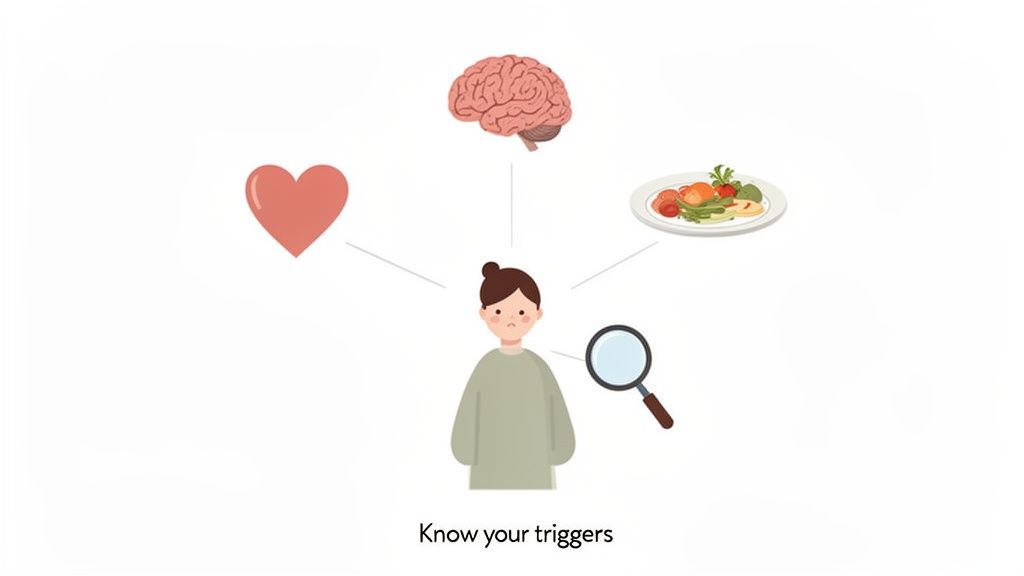
Let's get one thing straight right away: binge eating isn't a character flaw or a lack of self-control. It’s a complex and often painful cycle driven by emotions, stress, biology, and habits that have been wired into our brains over time. If you feel trapped in a loop of intense cravings followed by a wave of guilt and shame, you are definitely not alone.
This guide is designed to give you a realistic way forward. We're going to move past the generic "just eat less" advice and get into practical, evidence-based strategies that actually work. The very first—and most powerful—step is simply to build awareness. When you can pinpoint the real reasons behind your binges, you can finally start to dismantle the cycle and get your life back.
The Scope of the Challenge
It’s important to know that binge eating is a recognized health condition, not a personal failing. In fact, binge eating disorder (BED) is now the most common eating disorder in the world.
Here in the U.S., it’s estimated to affect 2.8 million people, which is more than anorexia and bulimia combined. Globally, food addiction—which often drives these behaviors—impacts about 20% of the population. You can learn more about the science behind this in our guide explaining what is food addiction.
Binge eating thrives in isolation and secrecy. The moment you start learning about it and seeking solutions, you take away its power. Awareness is the first step toward freedom.
Your Initial Action Plan to Stop Binge Eating
Getting started can feel like a huge mountain to climb, so let's make it simple. Your journey begins with this clear, three-part strategy. Think of these as the foundational pillars that will support everything else you do.
Here’s a breakdown of the core strategies we’ll cover, designed to help you start breaking the cycle today.
| Strategy | What It Means | Your First Action |
|---|---|---|
| Awareness | Becoming a detective of your own habits to identify what triggers a binge. | Start a simple journal to note when urges appear and what you're feeling or doing at that moment. |
| Immediate Action | Building a toolkit of go-to techniques to use when a craving hits hard. | Choose one simple distraction, like a 5-minute walk or calling a friend, to try next time an urge arises. |
| Long-Term Planning | Creating a sustainable food routine that nourishes your body and prevents extreme hunger. | Plan your next three meals. Don't focus on "good" or "bad" foods, just on consistency. |
By approaching this with curiosity instead of self-criticism, you can begin to untangle the patterns that have kept you stuck. This guide will walk you through each piece, giving you the tools and knowledge you need to reclaim your relationship with food for good.
Uncovering Your Personal Binge Triggers
Binge eating doesn't just happen. It almost never comes out of nowhere. More often than not, it’s a direct response to something specific—a feeling, a place, a person, or even just how your body feels. The first real step to stopping binge eating is to become a detective in your own life, figuring out what flips that switch.
Think of it like this: the binge is the symptom, not the disease. The real problem is whatever happened right before the urge hit. Once you start seeing what’s going on under the surface, you can finally tackle the root cause.
What Are You Feeling? Pinpointing Emotional Triggers
Emotions are powerful, and for so many of us, they're the main driver behind a binge. Tough feelings like stress, sadness, anger, or loneliness create a kind of internal static that food seems to quiet down, at least for a little while. The catch? That relief disappears fast, and what's left is usually guilt and shame, which just starts the cycle all over again.
Start looking for the patterns. Do you always head for the pantry after a stressful call with your boss? Does that quiet, lonely feeling on a Friday night send you straight to the freezer for ice cream?
These are some of the most common emotional culprits:
- Stress from work, money, or fighting with a partner.
- Loneliness or just feeling disconnected, especially at night or on weekends.
- Boredom, when food becomes a form of entertainment because nothing else is going on.
- Anxiety about something coming up or just a general sense of dread.
- Anger or frustration that you feel like you can't let out.
The moment you can connect an emotion to the urge, you've got the upper hand. You can start asking, "What do I really need right now?" instead of letting the autopilot take you to the kitchen.
Situational and Environmental Clues
Sometimes it’s not what you’re feeling inside, but what’s happening around you. These external triggers are all about the places, people, and times of day your brain has learned to associate with bingeing. Spotting them is key to breaking that automatic connection.
For instance, do you get an intense craving every time you drive past that one fast-food place on your way home? Maybe seeing a commercial for pizza is all it takes to set you off.
Keep an eye out for these common situational factors:
- Specific Times of Day: Many people struggle in the late afternoon or evening when energy is low and the day's structure is gone.
- Certain Locations: This could be your kitchen after everyone's asleep, the office breakroom with its endless supply of donuts, or even your car.
- Social Settings: Being around people who push food on you or make you feel judged can be a huge trigger.
- Visual Cues: Sometimes, just seeing the food is enough to kickstart a powerful craving.
Understanding the link between your environment and your urges is like getting a map of your personal binge landscape. Once you have the map, you can start planning new, safer routes to get through your day.
How Your Body Can Set You Up for a Binge
Your own body can send signals that trigger a binge, too. One of the biggest culprits is extreme hunger. When you’ve been restricting food all day or skipping meals, your body flips into survival mode. You're not just hungry; you're ravenous. This makes it almost impossible to stay in control when you finally do eat. It’s the classic, brutal binge-restrict cycle.
Another major player is how your body reacts to certain foods, especially sugar. Sugar cravings can hijack your brain's reward system in a way that’s scarily similar to addictive drugs, leading to energy crashes and wild mood swings. When you start tracking how you feel, you'll likely see a direct link between these sugar-induced highs and lows and your emotional state. This connection is a key insight you can use to make real, lasting changes. You can read more about the science behind this on olympicbehavioralhealth.com.
Becoming aware of all these triggers isn’t about blaming yourself. Not at all. It’s about gathering intel. Every time you identify a trigger, you’ve found another piece of the puzzle, and you’re one step closer to breaking free.
Your In-The-Moment Toolkit for Managing Urges
When a powerful urge to binge hits, it can feel like a tidal wave—overwhelming and seemingly impossible to resist. In these critical moments, willpower alone often isn't enough. It's like trying to hold back the ocean with a bucket. What you really need is a go-to toolkit of practical strategies that actually work when you're in the thick of it.
This is your emergency response plan. We're moving beyond generic advice to give you concrete techniques that create a crucial pause between the urge and the action. Think of these as circuit breakers. They interrupt the automatic, well-worn path your brain wants to take, giving you just enough space to make a different choice.
This decision tree shows how to pinpoint and respond to different triggers—whether they're emotional, situational, or physical—that can kickstart a binge.
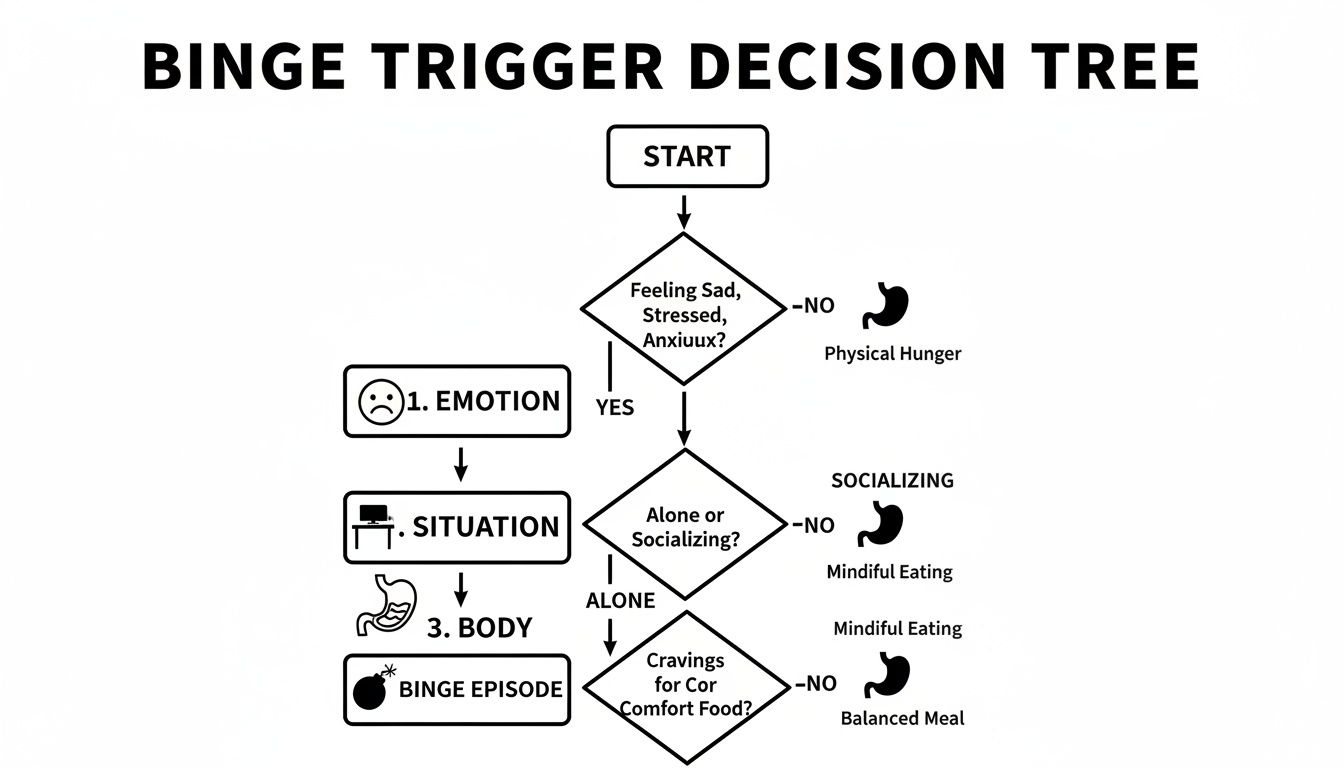
As the visual highlights, it all starts with awareness. When you can get to the 'why' behind the urge, you can pick a coping strategy that truly helps, instead of just defaulting to food.
Practice Urge Surfing
One of the most powerful mindfulness techniques I've seen work is called urge surfing. Instead of fighting a craving or immediately giving in, you simply observe it without judging yourself.
Picture the urge as a wave in the ocean. It slowly builds, crests, and then naturally fades away on its own. Your job isn't to stop the wave, but to learn how to ride it out until it passes.
Here’s how you can try it:
- Acknowledge the Urge: Just say to yourself, "Okay, a craving is here." No need for panic or self-criticism.
- Get Curious: What does it feel like? Notice the physical sensations. Is your stomach in knots? Are you feeling jittery? Just observe these feelings without getting swept away by them.
- Breathe Through It: Take some slow, deep breaths. This is a simple but incredibly effective way to calm your nervous system and keep you grounded in the here and now.
- Watch It Pass: Gently remind yourself that this feeling is temporary. Just like a wave, it will lose its power and recede.
The more you practice this, the more you'll start to believe that you are not your urges. You are the observer, capable of watching them come and go.
Create a Distraction Box
Sometimes, the best defense is a good offense—and that means redirecting your attention completely. This is where a "distraction box" (or even just a list on your phone) comes in handy. It’s your personalized collection of activities that require your full focus, pulling your mind away from the noise of the craving.
The goal isn't just to 'keep busy,' but to engage in something that is genuinely absorbing. It needs to occupy both your hands and your mind, making it tough to think about anything else.
Your box could have items ready for activities like:
- A tricky jigsaw puzzle you've been meaning to start.
- Knitting needles and yarn for a simple scarf.
- A specific, fascinating podcast episode you've saved just for this kind of moment.
- The number of a friend you can call for a quick, five-minute chat to change the subject.
- A journal and a good pen to scribble down everything you're feeling, no filter.
Having these things ready to go eliminates the "what should I do?" panic. You just grab something and dive in. And if you're looking for more ways to tune into your body's signals, you might find our guide on https://stopsugar.app/blog/mindful-eating-exercises helpful.
Use Your Tools Wisely
Getting a handle on binge eating starts with awareness, and some modern tools can offer powerful support. For instance, using an app like StopSugar to check in with your daily intake can reveal hidden patterns between your mood and sugar consumption, helping you spot triggers before they take over.
In moments of intense crisis, a panic button feature can offer instant alternative activities and coping strategies to derail cravings on the spot. To build up your resistance even further, exploring options like the best supplement to curb sugar cravings can provide an extra layer of support.
By combining these tools, you create a multi-faceted defense system that gives you more ways to successfully navigate those tough moments.
Building a Food Routine That Prevents Binges
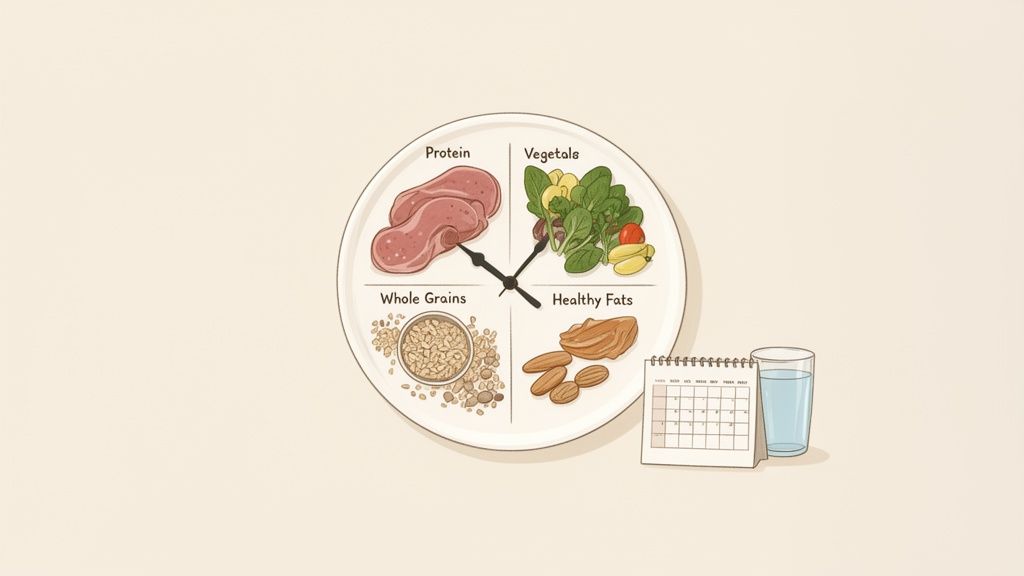
It’s a common trap: believing that strict dieting is the fix for binge eating, when in reality, it's often the very thing that triggers it. This cycle of harsh restriction followed by an overwhelming binge is a tough one to break. To truly stop, you need to step off that rollercoaster and build a new relationship with food—one grounded in consistency, nourishment, and balance.
This isn't about forbidding foods or obsessively counting calories. It's about creating a gentle, predictable eating structure that keeps your body satisfied and your mind at ease. When you eliminate extreme hunger, you disarm one of the most powerful triggers for a binge.
The Power of Consistent Fueling
One of the simplest and most powerful strategies to head off a binge is to eat regularly throughout the day. When you go hours and hours without food, your blood sugar plummets, hunger hormones surge, and your body goes into a primal state of panic. Your brain starts screaming for quick energy, making a binge feel almost inevitable.
To sidestep this biological trap, aim for a predictable rhythm of meals and snacks.
- Eat every 3-4 hours: This is the sweet spot for keeping blood sugar stable and preventing that ravenous, out-of-control hunger from taking over.
- Never skip meals: Even if you don't feel super hungry, having a small, balanced meal reinforces your routine and keeps your metabolism humming.
- Plan your food ahead of time: Just knowing what your next meal will be cuts down on decision fatigue and closes the door on impulsive, binge-driven choices. Our guide on https://stopsugar.app/blog/meal-prep-ideas-for-weight-loss offers some great ideas that focus on balance, not deprivation.
Think of regular meals as preventative medicine for binge urges. By consistently giving your body the fuel it needs, you’re not just managing hunger—you’re proactively building a defense against the physical and psychological pull of a binge.
Learning how to stick to a routine is a skill that will support you through this entire journey, especially when life gets chaotic. It creates a foundation of stability you can fall back on.
Crafting Satisfying, Binge-Proof Meals
What you eat matters just as much as when you eat. The goal is to build meals that leave you feeling both physically full and mentally satisfied. This keeps you nourished for longer and quiets the constant food chatter that often precedes a binge.
Let's ditch the "good" vs. "bad" food labels. Instead, focus on building balanced plates that include three key components at every meal:
- Protein: Foods like chicken, fish, beans, tofu, and Greek yogurt are digested slowly, which helps you feel full and satisfied.
- Fiber: Found in vegetables, fruits, and whole grains, fiber adds satisfying bulk to your meals and helps keep blood sugar levels steady.
- Healthy Fats: Sources like avocado, nuts, seeds, and olive oil not only make meals more delicious but also contribute to lasting satiety.
This powerful trio works together to prevent the sharp energy crashes that can send you running for high-sugar, high-fat foods. It’s also about building resilience. Research shows that food insecurity can increase the likelihood of binge eating by 1.66 times. Focusing on accessible, satisfying swaps creates a plan you can actually stick to.
For those with a history of dieting, it can be tough to trust this new process. Using features like the achievement badges and AI coaching in the StopSugar app can help you turn this knowledge into a real, lasting habit and reduce the risk of falling back into old patterns.
Simple Food Swaps to Reduce Binge Urges
Making small, smart swaps can make a huge difference without making you feel deprived. Here are a few ideas to get you started.
| Instead Of This Binge Food | Try This Satisfying Swap | Why It Helps |
|---|---|---|
| Potato Chips | Air-popped popcorn with a little salt and nutritional yeast | You still get the salty, crunchy satisfaction, but with a big boost of fiber to help you feel full. |
| Sugary Cereal or Granola | Oatmeal with berries, nuts, and a spoonful of Greek yogurt | This combination provides slow-releasing carbs, protein, and healthy fats, preventing a mid-morning sugar crash. |
| Ice Cream | A frozen banana blended with a splash of milk and a bit of cocoa powder | You get the creamy, sweet texture you're craving, but with natural sugars and potassium instead of a sugar overload. |
| Candy Bars | A handful of almonds and a few squares of dark chocolate (70% or higher) | The protein and fat from the nuts help balance the sugar from the chocolate, providing steady energy and satisfying the craving. |
These aren't rules, just ideas. The goal is to find swaps that you genuinely enjoy and that leave you feeling good.
This isn't just another diet. It’s a complete shift in how you think about food—moving from fear and restriction to a place of nourishment, balance, and peace. By creating this structure, you're not just learning how to stop binge eating; you're building a healthier, more trusting relationship with food, one satisfying meal at a time.
What to Do When You Slip Up (Because It Will Happen)
Let's get one thing straight from the jump: your path to breaking free from binge eating won't be a perfect, straight line. There are going to be tough days. You'll have moments of doubt and, yes, times when you slip up. This isn't a sign you're failing—it's just part of being human and working through a deeply ingrained habit.
The real skill to build here is resilience. It’s about learning to handle those moments with curiosity, not criticism. Instead of seeing a setback as proof that you can't do this, think of it as a clue. It’s valuable intel that helps you get a better handle on your triggers and fine-tune your game plan.
One of the biggest traps you can fall into is the "all-or-nothing" mindset. It's that little voice in your head that says, "Well, I already messed up, so I might as well go all in." That kind of thinking is what keeps the binge-and-guilt cycle spinning. Your job is to learn how to quiet that voice and talk to yourself with a little more kindness.
Turn a Stumble into a Stepping Stone
When a slip-up happens, your gut reaction might be a wave of shame or frustration. The trick is to pause, take a deep breath, and switch from judgment to detective mode. This is your chance to learn something really important about what you need.
Instead of beating yourself up, try asking a few gentle questions:
- What was going on right before the urge got overwhelming? Was I exhausted? Stressed from a fight with my partner? Feeling lonely? Or just starving because I skipped lunch?
- Which of my tools did I forget to use? Did I try to just power through the urge instead of grabbing my distraction box or practicing the urge surfing technique?
- What can I learn from this? Maybe the big takeaway is that I need a more filling afternoon snack. Or maybe I need to call a friend the next time I start feeling that pang of isolation.
Think of a setback like taking a wrong turn on a road trip. You don't just give up and drive home. You pull over, check the map, and figure out how to get back on the right road.
This simple shift in perspective turns a tough moment into a powerful learning opportunity. Every slip gives you a new piece of the puzzle, making your plan stronger and better suited to your actual life.
The Power of Being Kind to Yourself
Self-compassion isn't some fluffy, nice-to-have extra. It's a non-negotiable tool in your recovery toolkit. Berating yourself only digs the hole of shame deeper, and shame is a massive trigger for binge eating. Being kind to yourself is what actually breaks the cycle.
Think about it: if your best friend came to you after a setback, would you call them a failure? Never. You'd listen, offer a hug, and tell them to dust themselves off. It's time to start giving yourself that same grace.
When to Call in for Backup
While these strategies can make a huge difference, sometimes you need a little more support to really move forward. Reaching out for professional help isn't a sign of weakness—it's a sign of strength. It means you're serious about getting better.
It might be time to find a professional if:
- Binge episodes are happening often and feel completely out of your control.
- Your physical health or your mood is taking a major hit.
- You feel stuck in the binge-and-restrict loop no matter what you try.
- You know you’re using food to numb deep emotional pain or deal with past trauma.
Professionals can offer proven therapies like Cognitive Behavioral Therapy (CBT), which is one of the most effective treatments for binge eating. CBT gives you a structured way to identify and change the thought patterns and behaviors that keep you stuck.
Ignoring these patterns can have devastating consequences. Disordered eating contributes to 10,200 deaths in the U.S. every single year—that's a life lost every 52 minutes. These behaviors also lead to a global loss of 3.3 million healthy life years, which is why getting the right support is so important. You can find more insights on the real impact of food addiction on olympicbehavioralhealth.com.
This is your journey, but you absolutely do not have to do it alone. Pairing your own efforts with professional guidance can create a powerful combination that finally helps you find lasting freedom from binge eating.
Got Questions About Binge Eating? You're Not Alone.
When you decide to tackle binge eating, a million questions can start swirling around. It’s completely normal to wonder what the road ahead looks like, how long it will take, and what recovery actually feels like. Let's walk through some of the most common questions I hear and get you some clear, practical answers.
"How Long Will This Take?"
This is almost always the first thing people ask, and the most honest answer is: it's different for everyone. There’s no set timeline because the reasons behind binge eating are so deeply personal. Think of it less like a race and more like learning a new skill—it takes patience and practice to unlearn old reflexes and build new, healthier ones.
Some people feel a real shift in just a few weeks. The urges might become less frequent, or they just feel more in charge. For others, it might be a journey of several months to build a strong foundation.
The goal isn't to get to some imaginary finish line as fast as possible. It's about building steady, consistent momentum.
The most important metric isn't speed; it's progress. Celebrate the small wins. Did you go one extra day without a binge? Did you use a coping tool instead of turning to food? That's what really matters. Healing your relationship with food is all about progress, not perfection.
Instead of getting hung up on "how long," try asking, "what can I work on today?" This simple shift takes the pressure off and keeps you focused on the small, daily actions that create real, lasting change.
"Does This Mean I Can Never Eat My Favorite Foods Again?"
Absolutely not. In fact, you should still eat your favorite foods. One of the biggest mistakes people make is creating a list of "bad" or "forbidden" foods. This all-or-nothing thinking almost always backfires. Why? Because telling yourself you can never have something just makes you want it more, setting the stage for a future binge.
The real goal isn't to eliminate foods; it's to change the way you eat them. It’s about moving from a mindset of restriction to one of mindful enjoyment.
Here’s what that looks like in the real world:
- The Binge Pattern: You swear off cookies forever. A week later, after a brutal day at work, you find yourself alone in the kitchen, eating an entire package and feeling completely out of control and ashamed.
- The Mindful Pattern: You decide you want a cookie. You meet a friend at a nice little bakery, sit down, and savor one amazing, high-quality cookie. You enjoy every bite, feel zero guilt, and then you just move on with your day.
See the difference? Same food, totally different experience. The key is to reintroduce these foods in a way that feels calm, intentional, and puts you back in the driver's seat.
"What’s the Real Difference Between Overeating and Binge Eating?"
This is a super important question. People often use the terms interchangeably, but they describe two very different things.
Most of us overeat sometimes. Think Thanksgiving dinner or a big celebration with friends. You might eat until you're uncomfortably full and feel a bit sluggish after. It's a conscious choice, and while you might not feel great physically, you're still in control.
Binge eating is a clinical behavior defined by three key elements:
- A Large Amount of Food: Eating a quantity of food that is clearly larger than what most people would eat in a similar situation.
- Loss of Control: This is the big one. It’s a powerful feeling that you simply cannot stop eating. It feels like you're on autopilot.
- Serious Distress: The episode is followed by a wave of intense guilt, shame, disgust, or depression. This is often why binges happen in secret—the embarrassment can be overwhelming.
Simply put, overeating is something you do. Binge eating is something that feels like it’s happening to you.
"If I Stop Bingeing, Will I Lose Weight?"
It's possible, yes. When you stop binge eating, your overall calorie intake often goes down, which can lead to weight loss. But—and this is a big but—making weight loss your main goal can be a trap.
Focusing too much on the number on the scale can easily throw you right back into the old diet mindset of restriction and control. And that is the exact mindset that fuels the binge-restrict cycle in the first place.
Your primary mission is to heal your relationship with food. Full stop. It’s about learning to listen to your body, managing your emotions without using food as a crutch, and finally treating yourself with a bit of kindness.
Think of a healthier weight as a potential side effect of doing this important work. When you put your mental and emotional well-being first, you build sustainable habits that naturally support your physical health for the long haul.